

What Jewelry Retouching Means and Why It Matters for Your Brand
A jewelry retouching company is a specialized post-production service provider that enhances jewelry photographs to make pieces look as striking on screen as they do in person. This goes well beyond basic photo editing. Think of it as a full discipline: correcting color, removing flaws, refining reflections, and bringing out the life in metals and gemstones so every image is ready to sell.
If you sell jewelry online, you already know the stakes. Shoppers cannot hold your product, rotate it under light, or feel its weight. Your image is the entire experience. And choosing the wrong retouching partner can quietly cost you sales, returns, and brand credibility. This guide is written for jewelry brands, online sellers, and studios who want to evaluate retouching partners with clear eyes, not marketing hype.
What a Jewelry Retouching Company Actually Does
The scope of jewellery image retouching covers a wide range of tasks. Background removal and pure white isolation prepare images for marketplaces like Amazon and Etsy. Color correction ensures that a sapphire reads as true blue, not washed-out gray. Metal reflection cleanup removes unwanted artifacts, studio equipment reflections, and fingerprints from gold and silver surfaces. Gemstone enhancement brings out brilliance and fire without making stones look artificial. Shadow creation adds depth and dimension, while high end jewelry retouching ensures every prong, link, and setting detail is crisp and flawless across an entire catalog.
Why Image Quality Drives Jewelry Sales
The connection between polished product imagery and buyer confidence is not theoretical. Research compiled by LetsEnhance shows that 56% of online shoppers explore product images before reading any text on a product page, and 77% say high-quality visuals are important to their purchase decisions. On the return side, 71% of consumers have sent items back because the product did not match its description, a gap that accurate retouching directly closes.
A single poorly retouched jewelry image does not just lose one sale. It quietly erodes trust across your entire catalog, while the cost of professional retouching is a fraction of what a single returned piece costs in shipping, restocking, and lost customer confidence.
Jewelry, though, is not like photographing a sneaker or a handbag. The reflective surfaces, microscopic details, and color precision involved make it one of the most technically demanding product categories to retouch, and that difficulty is exactly where many providers fall short.

Why Jewelry Is Harder to Retouch Than Any Other Product
Every product category has its quirks in post-production. Apparel needs consistent color across fabrics. Electronics require clean lines and accurate screen displays. But jewelry image retouching sits in a league of its own. The combination of highly reflective metals, translucent gemstones, and incredibly small physical dimensions creates a perfect storm of technical challenges that general retouchers rarely have the training or patience to handle well.
Understanding these challenges matters if you are evaluating a retouching partner. A company that treats a diamond ring the same way it treats a leather wallet will produce images that look flat, inaccurate, or obviously manipulated. Here is what makes jewelry retouching so demanding.
Reflective Surfaces and Unwanted Light Artifacts
Gold, silver, platinum, and rhodium-plated metals behave like tiny curved mirrors. During a photoshoot, they pick up everything in the studio: softboxes, tripod legs, the photographer's hands, even the color of nearby walls. You will often see warm orange casts on white gold simply because the shooting table had a wooden surface nearby.
Cleaning up these reflections is painstaking work. A retoucher has to remove each unwanted artifact while preserving the natural metallic luster that makes the piece look real. Remove too much, and the metal looks like matte plastic. Leave too much, and the image is cluttered with distracting highlights. This balancing act requires a trained eye and a deep understanding of how light interacts with polished metal surfaces, something a general product retoucher rarely encounters at this level of complexity.
Tiny Details at Macro Scale
Jewelry photography typically involves shooting from very close range, often with the camera just 8 to 12 inches from the piece. At that distance, macro lenses reveal every flaw invisible to the naked eye: dust particles lodged between prongs, micro-scratches on band surfaces, tiny casting imperfections, and uneven polish marks.
There is also a fundamental optical challenge. As JewelryShoot explains, when photographing small items like rings from up close, a camera lens cannot focus on the entire product in a single shot. The front may be sharp while the back falls into blur, or vice versa. The solution is a technique called focus stacking: capturing multiple images of the same piece with different areas in focus, then blending them together in post-production to create one fully sharp composite. A single ring might require three or more stacked exposures just to achieve edge-to-edge clarity. For larger print applications like magazine ads, that number can climb to 10 or 15 stacked images.
This means the retoucher is not just editing one photograph. They are aligning, masking, and compositing multiple exposures before the actual retouching even begins. If a jewelry retouching company does not mention focus stacking in its workflow, that is worth questioning.
Color Accuracy for Gemstones and Precious Metals
Imagine you are selling a tanzanite ring online. The stone's violet-blue hue is what makes it desirable, but under different lighting conditions, tanzanite can photograph as anything from deep purple to grayish blue. A retoucher needs to know the target color and adjust precisely, without pushing the stone into sapphire territory or washing it out entirely.
The same problem applies to metals. White gold, platinum, and silver look nearly identical in raw photographs, yet each has a distinct tone that buyers expect to see. Rose gold can shift toward copper or salmon depending on white balance settings. Yellow gold can appear greenish under certain studio lights. Reproducing these differences accurately, and keeping them consistent across a 50-piece collection, demands calibrated monitors, controlled color workflows, and genuine familiarity with how precious materials look in real life.
Color drift is one of the fastest ways to trigger returns. A customer who orders a ruby ring and receives something that looks more like garnet in person will not come back.
The Five Challenges That Set Jewelry Retouching Apart
When you step back and compare jewelry retouching to standard product editing, five technical hurdles consistently separate the two:
- Complex reflection management - Curved, polished metal surfaces create layered reflections that require selective cleanup without flattening the three-dimensional appearance of the piece.
- Focus stacking and composite assembly - Macro shooting distances produce shallow depth of field, requiring multiple exposures to be aligned and blended before retouching can start.
- Microscopic flaw correction - Dust, scratches, prong irregularities, and casting marks invisible to the eye become prominent at high magnification and must be removed without altering the piece's structure.
- Precise color reproduction - Gemstone hues and metal tones must match real-world appearance across varying lighting conditions, monitor calibrations, and output formats.
- Translucency and light interaction - Diamonds, opals, and colored gemstones transmit, refract, and scatter light in ways that opaque products never do, requiring retouchers to enhance brilliance and fire without creating an artificial or overprocessed look.
Any retouching partner that glosses over these challenges, or prices its jewelry work the same as a cheap jewelry photo retouch service handling basic product shots, likely lacks the specialization to deliver results that protect your brand. The techniques required to solve each of these problems are specific, layered, and worth understanding before you sign a contract.
Core Jewelry Retouching Techniques Every Buyer Should Understand
Knowing that jewelry is difficult to retouch is one thing. Knowing exactly how a skilled retoucher solves each problem is what gives you the ability to evaluate whether a provider actually delivers professional jewelry retouching services or just claims to. The techniques below form the backbone of high-quality jewellery retouching, and understanding them puts you in a much stronger position when reviewing portfolios, comparing quotes, or questioning a company's workflow.
Metal Smoothing and Reflection Control
Polished gold, silver, and platinum surfaces are magnets for visual noise: fingerprints, micro-scratches, uneven reflections, and color casts from the shooting environment. The goal is to clean all of that up while keeping the metal looking like metal, not airbrushed plastic.
Retouchers typically approach this in two stages. First, they use frequency separation, a technique that splits an image into a texture layer and a color/tone layer. This allows them to smooth out blotchy reflections and uneven tonal transitions on the metal surface without destroying the fine grain and natural texture underneath. Think of it as ironing out wrinkles in fabric without changing the weave pattern.
Second, they apply dodge-and-burn adjustments, selectively lightening and darkening small areas to reshape how light appears to fall across the piece. On a gold band, for example, a retoucher might brighten the top curve where a highlight naturally sits and deepen the shadow along the inner edge to restore a convincing sense of roundness. The key is subtlety. Overdone dodge-and-burn work creates a cartoonish, hyper-polished look that experienced buyers will notice immediately.
For pieces with complex geometry, like a chain necklace or a watch bracelet with dozens of individual links, this process is repeated across every visible surface. It is time-intensive, and it is one of the clearest indicators of whether a provider offers genuine jewelry photo retouching services or just runs a batch filter and calls it done.
Gemstone Brilliance and Sparkle Enhancement
Diamonds and colored gemstones interact with light in ways that cameras struggle to capture faithfully. The fire, brilliance, and scintillation you see when you tilt a diamond under a lamp rarely translate into a static photograph without some post-production help.
Skilled retouchers enhance gemstone sparkle through a combination of techniques. Selective contrast adjustments increase the difference between the bright facet highlights and the darker areas between them, which makes the stone appear more lively and dimensional. Highlight painting, done manually with a soft brush on a separate layer, adds small points of light to key facets, mimicking the way a diamond catches and scatters light in person. For colored stones, careful saturation control ensures the hue looks rich and accurate without crossing into neon territory.
The line between enhancement and overprocessing is thin. As Studio Pixel Park notes, pushing brightness and saturation too far on diamonds makes them lose natural depth and look fake, which erodes buyer trust rather than building it. A well-retouched gemstone should look like the best version of itself under ideal lighting, not like a CGI render.
Background Cleanup and Shadow Work
Most ecommerce platforms require a pure white background, and marketplaces like Amazon enforce strict standards around it. Background removal for jewelry is more demanding than for larger products because of intricate outlines: the tiny gaps between chain links, the open space inside a hoop earring, or the delicate prongs holding a stone in place. Sloppy masking leaves visible halos or clips away fine details that make the piece look authentic.
Once the background is clean, shadow work brings the image back to life. A piece floating on flat white with no shadow looks cut out and unnatural. Professional retouchers create natural drop shadows or reflection surfaces that ground the jewelry and give it a sense of physical presence. The shadow style, soft and diffused versus sharp and directional, is typically matched to the brand's visual identity and kept consistent across the entire product catalog.
Color Grading and Consistency Across Collections
Imagine browsing a jewelry store's website and noticing that the white gold in one ring looks slightly blue, while the same metal in the next ring appears warm gray. That inconsistency signals carelessness, even if each image looks fine on its own.
Color grading across a collection involves standardizing white balance, exposure, and tonal curves so that every piece in a product line shares the same visual language. Retouchers working on a 20- or 50-piece catalog will establish a master color profile early in the process, then apply it as a baseline to every image before making individual adjustments. This is where the difference between a transactional editing service and a true jewelry retouching partner becomes obvious. Consistency requires discipline, calibrated monitors, and a workflow designed for catalog-scale output, not just single-image polish.
When you outsource jewelry photo retouching services, ask how the provider handles collection-wide consistency. If they cannot explain their process for maintaining uniform tone and exposure across a batch, that is a gap worth taking seriously.
Technique-to-Jewelry Mapping
Not every technique applies equally to every piece. The table below maps each core retouching method to the jewelry types where it matters most and the skill level it demands.
| Technique | Primary Jewelry Types | Why It Matters | Skill Level Required |
|---|---|---|---|
| Metal smoothing and reflection control | Rings, watches, bracelets | Removes fingerprints, scratches, and studio reflections while preserving metallic luster | Advanced |
| Gemstone brilliance enhancement | Rings, earrings, loose stones | Restores fire and sparkle that cameras fail to capture in a single exposure | Advanced |
| Background removal and shadow creation | All jewelry types | Meets marketplace standards and adds depth for a realistic presentation | Intermediate to advanced |
| Color grading and collection consistency | All jewelry types (catalog scale) | Ensures uniform tone, white balance, and exposure across an entire product line | Advanced |
| Focus stacking and composite assembly | Rings, loose stones, watches | Achieves full sharpness on small items shot at macro distances | Expert |
These techniques are not optional extras. They are the baseline of what professional jewellery retouching looks like. The real question is how each method adapts when the jewelry itself changes, because a diamond solitaire ring and a loose emerald present very different retouching priorities.

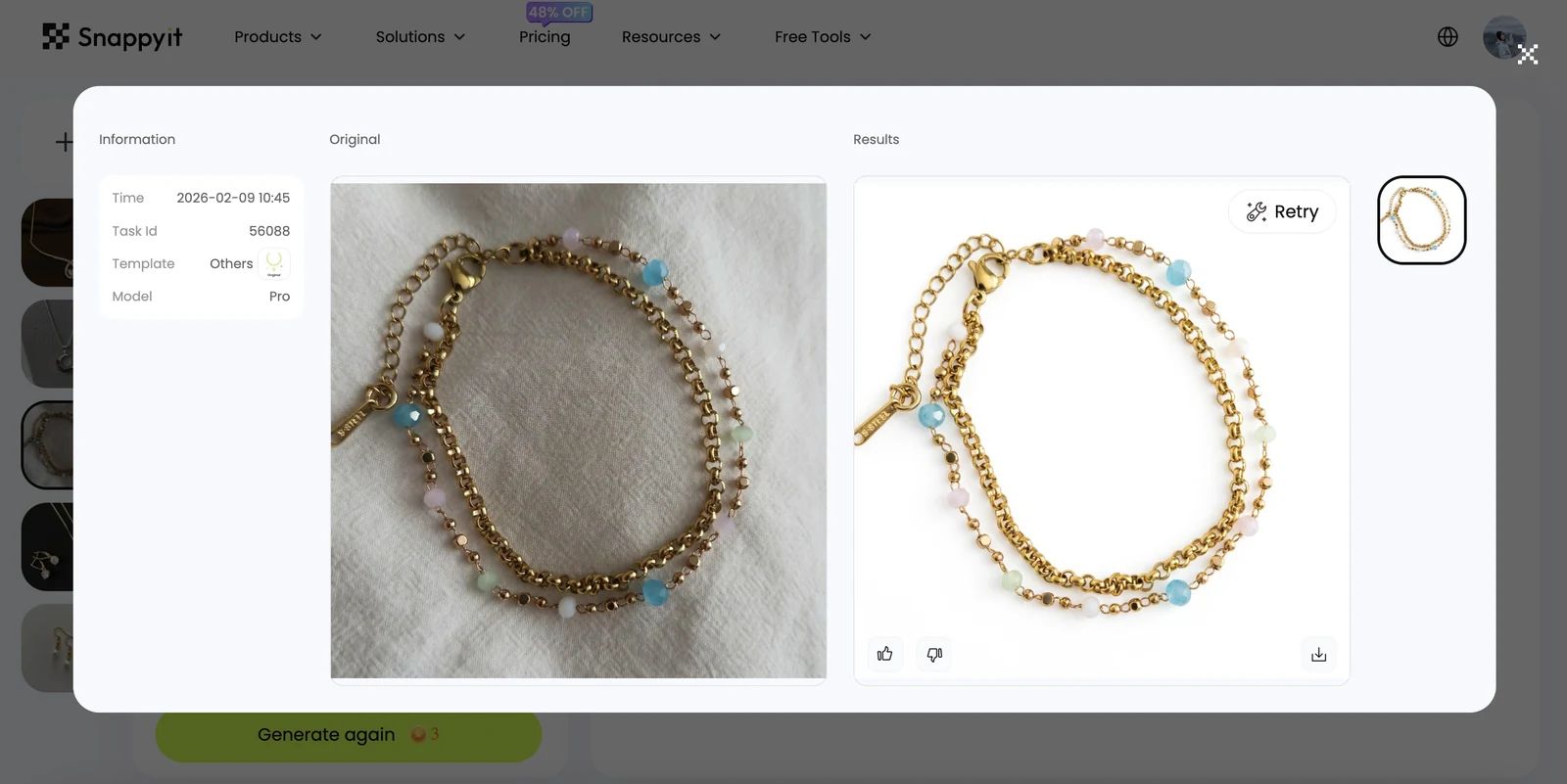
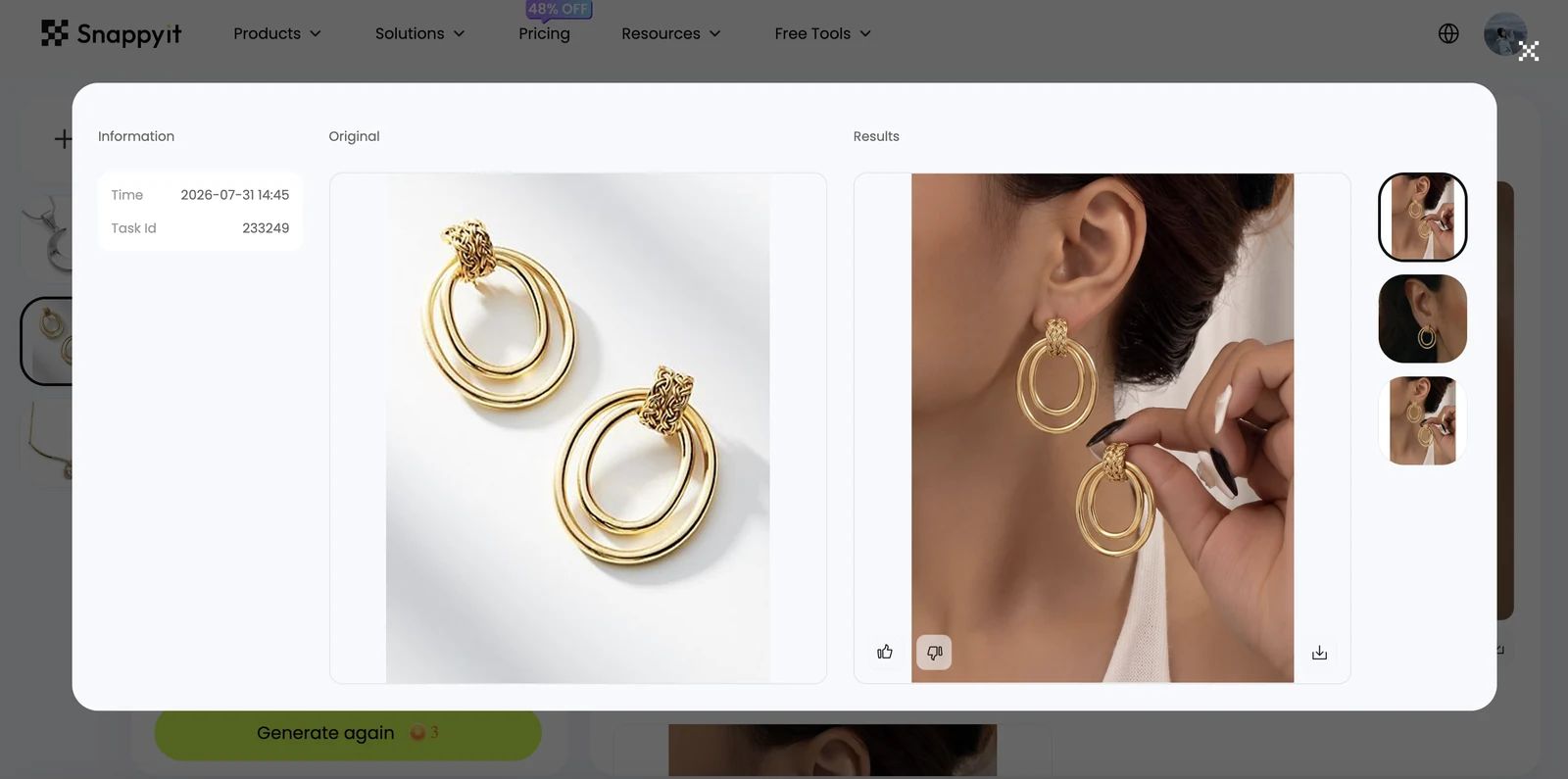
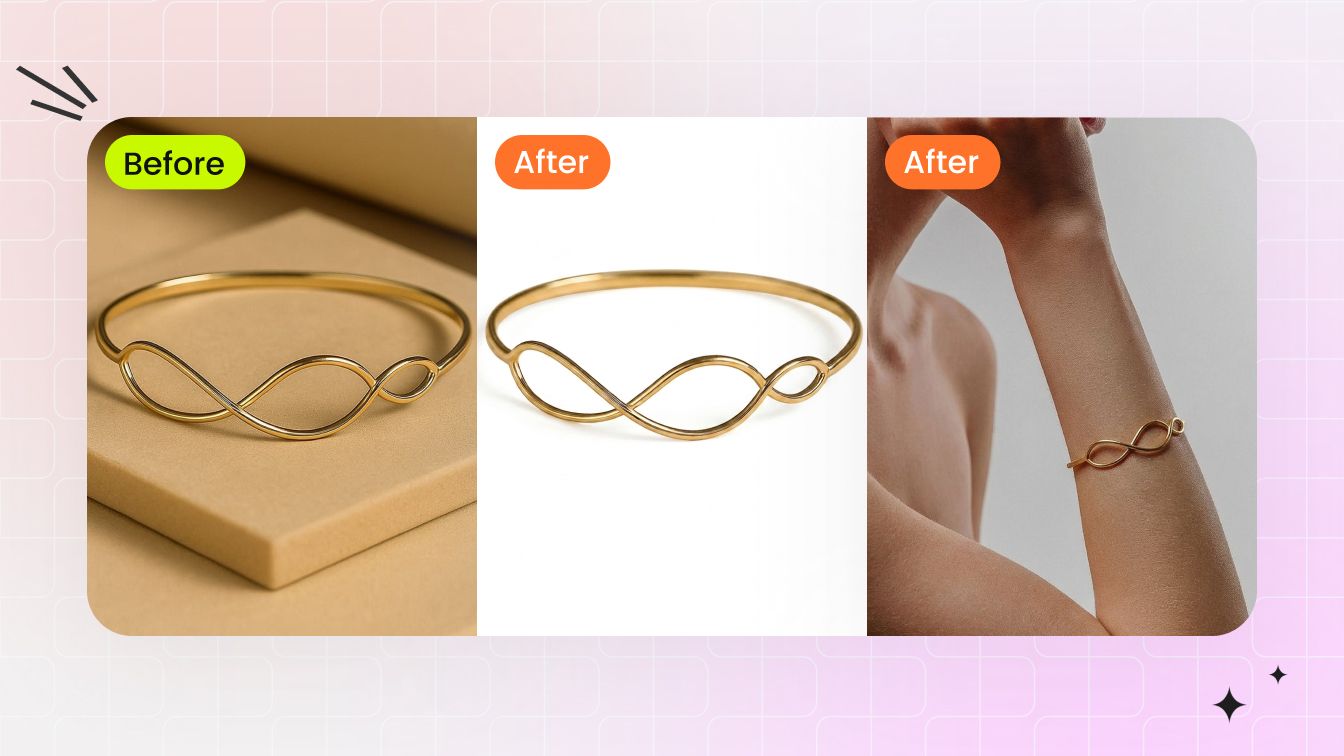
Try the AI version first. For most catalog work, AI tools clear the bar for quality and ship in seconds. Try Snappyit AI Jewelry Retouch free →
How Retouching Needs Differ by Jewelry Type
A diamond solitaire ring and a strand of pearls may both live in the same display case, but they demand completely different things from a retoucher. The techniques covered above apply broadly, yet the way they are prioritized, combined, and executed shifts dramatically depending on what type of jewelry is in the frame. This distinction matters when you are choosing a retouching partner, because a company that produces flawless ring imagery may struggle with the unique demands of a loose gemstone or a luxury watch.
Here is how jewelry photo retouching priorities break down across the four most common categories.
Rings and Bands
Rings are the most frequently retouched jewelry type, and for good reason. They are the bestselling category in online jewelry retail, and they present a concentrated set of challenges in a very small physical space.
The center stone is the hero of most ring images. A retoucher needs to enhance its brilliance and fire while keeping the surrounding metalwork clean and detailed. Prong work is especially critical. At macro magnification, prongs that look perfectly fine to the naked eye can appear uneven, slightly bent, or rough at the tips. Cleaning these up without making them look unnaturally uniform takes careful manual work.
Scale is another subtle challenge. Rings are tiny objects, and buyers need to understand their proportions from a photograph alone. Retouchers help by ensuring the band width, stone size, and setting height all read clearly, often by refining shadows and highlights that define the piece's three-dimensional shape. If the retouching flattens those depth cues, the ring looks like a two-dimensional graphic rather than something you could slide onto your finger.
Necklaces and Bracelets
Long, curved pieces introduce problems that compact items like rings simply do not have. A 16-inch necklace or a tennis bracelet stretches across the frame, and lighting rarely falls evenly across its entire length. You will often see one end of a chain looking bright and well-defined while the other fades into shadow or picks up a color cast from the studio environment.
Retouchers working on necklaces and bracelets spend significant time on chain link consistency. Every link needs to reflect light in a believable, uniform way. If some links appear polished and others look dull or discolored, the piece feels cheap regardless of its actual quality. Clasp cleanup is another area that separates careful jewelry photo editing from rushed work. Clasps are functional components that rarely photograph well, often showing tool marks, spring mechanisms, or awkward reflections. A skilled retoucher cleans these up while keeping the clasp recognizable so buyers know what closure type they are getting.
For pieces displayed in a draped or curved layout, the retoucher also needs to manage how shadows interact with the curves. Harsh shadows under a looped chain can make the image look cluttered, while no shadow at all makes the necklace appear to float unnaturally.
Watches
Watch retouching is arguably the most precision-intensive subcategory in jewelry photo editing service work. A luxury watch is part jewelry, part mechanical instrument, and buyers expect every detail to be legible and flawless.
The dial is the focal point. Hour markers, brand logos, subdial text, and date windows all need to be crisp and readable. Any softness or blur on the dial face immediately undermines the image's credibility. As product photographer Ian Knaggs explains, post-production for luxury watches should enhance what is already there rather than making drastic changes, with selective adjustments to the watch face features, body, and strap using curves layers and layer masks to refine the final result.
Crystal reflections are a constant headache. The glass or sapphire crystal covering the dial acts as a mirror, picking up studio lights, camera equipment, and surrounding objects. Removing these reflections while preserving the transparency and depth of the crystal requires careful masking and tonal work. Push too hard, and the watch looks like it has no crystal at all.
Bracelet link uniformity is the third major concern. A metal watch bracelet can have dozens of individual links, each reflecting light at a slightly different angle. The retoucher needs to harmonize these reflections so the bracelet reads as one cohesive surface rather than a patchwork of bright and dark segments. This is the same link-by-link consistency challenge that necklaces present, but compressed into a tighter, more geometrically precise form.
Loose Gemstones
Presenting an unmounted stone is a unique retouching challenge because there is no setting to provide context, scale, or visual framing. The stone has to sell itself entirely on its own merits: cut quality, color saturation, clarity, and transparency.
For loose gemstones, color accuracy becomes the single most important retouching priority. As GIA's photography guide notes, a gemstone's color is critical to its identification and grading, yet photographs often fail to represent true-to-life hues. Inaccurate color reproduction leads to customer frustration and hesitation. A retoucher working on loose stones needs to understand how different gem species look under controlled lighting and how to correct for the color shifts that cameras inevitably introduce.
Transparency and light interaction add another layer of complexity. A well-cut sapphire transmits light through its body, creating depth and internal glow. Capturing and enhancing that effect in post-production, without making the stone look like colored glass, requires a retoucher who understands gemological optics, not just Photoshop tools. RapNet highlights that gemstones act like tiny mirrors, reflecting everything around them, and that unwanted reflections, excessive glare, and harsh lighting can obscure details and distort a stone's natural beauty.
This is exactly why a company that specializes in diamond ring retouching may not be the right fit for loose colored gemstone work, and vice versa. Ring retouching emphasizes metal cleanup, prong detail, and setting context. Loose stone retouching is almost entirely about color fidelity, light behavior, and presenting cut quality without any supporting visual framework. The skill sets overlap, but the priorities are different enough that you should ask any potential partner for samples specific to your product type.
Retouching Priorities by Jewelry Category
The table below maps the primary focus areas, common challenges, and provider qualities to look for across each major jewelry type.
| Jewelry Type | Primary Retouching Focus | Common Challenges | What to Look for in a Provider |
|---|---|---|---|
| Rings and bands | Center stone enhancement, prong cleanup, depth and scale definition | Uneven prongs at macro scale, shallow depth of field requiring focus stacking, small size makes proportions hard to convey | Strong before-and-after ring samples, evidence of focus stacking workflow, attention to fine prong and pave detail |
| Necklaces and bracelets | Chain link consistency, clasp cleanup, even tonal balance across full length | Uneven lighting across long curved pieces, shadow management on draped layouts, individual link reflections varying widely | Portfolio showing full-length chain and bracelet work, consistent link-to-link tone, clean clasp rendering |
| Watches | Dial legibility, crystal reflection removal, bracelet link uniformity | Glass or sapphire crystal mirrors studio environment, small text and markers must stay sharp, dozens of bracelet links need harmonized reflections | Dedicated watch retouching samples, experience with luxury brand standards, precision in dial and text detail |
| Loose gemstones | Color accuracy, transparency and light behavior, cut quality presentation | No setting context to anchor the image, color shifts between gem species are subtle but critical, light transmission must look natural | Gemstone-specific portfolio with multiple stone types, demonstrated color fidelity across species, understanding of gemological optics |
The takeaway is straightforward: not all jewelry retouching is the same job. A provider's ability to handle one category well does not guarantee they can handle another. Before committing, ask for samples that match your specific product mix. If a company cannot show you relevant work for the jewelry types you actually sell, that gap tells you something important about whether their expertise fits your needs, especially as the tools and workflows behind retouching continue to evolve.
AI-Powered vs. Manual Jewelry Retouching and What It Means for You
The tools and workflows behind jewellery photo retouching are shifting fast. A few years ago, every image passed through a human retoucher's hands from start to finish. Today, AI-driven software handles a growing share of the work, and the line between automated and manual output is not always obvious to buyers. Understanding where that line sits, and what falls on each side of it, directly affects the quality, cost, and turnaround you can expect from any jewelry retouching service you evaluate.
What AI Can Handle in Jewelry Retouching
AI tools trained on jewelry imagery have become genuinely effective at tasks that are repetitive and rule-based. Background removal is the most mature capability: algorithms can isolate a ring or necklace from its shooting surface and place it on pure white in seconds, handling even the small gaps between chain links or prong tips that used to require careful manual masking.
Beyond backgrounds, AI now handles batch color correction, basic dust and scratch removal, initial exposure normalization, and sharpness improvements with reasonable consistency. A 2026 review of AI jewelry retouching tools found that specialized platforms can detect common problems in jewelry images, including surface noise, uneven lighting, and minor blemishes, and fix them automatically while preserving fine details like engravings and stone edges. For catalog-scale jewelry image editing, where hundreds of SKUs need a clean, uniform baseline, these capabilities save significant time and money.
Consistency is another quiet advantage. When you rely on different human editors across sessions, results naturally vary in color balance, shadow density, and overall tone. AI applies the same corrections identically to every image in a batch, which matters when you are building a cohesive product catalog.
Where Manual Expertise Remains Essential
AI handles the predictable parts well. The unpredictable parts are a different story.
Gemstone brilliance enhancement, the kind that makes a diamond's fire look alive rather than flat, still requires a human retoucher painting highlights onto individual facets and adjusting contrast selectively. Complex reflection cleanup on curved metal surfaces, where a retoucher needs to decide which reflections to keep and which to remove to preserve a natural three-dimensional look, involves judgment calls that algorithms cannot reliably make. Focus stacking composites, where multiple exposures are aligned and blended to achieve full sharpness on a macro shot, demand manual precision in masking transitions. And creative shadow work, matching shadow style to a brand's visual identity, remains a subjective decision that benefits from human interpretation.
As PixelRetouching notes, very complex reflections, luxury-grade color calibration, and high-end advertising imagery still need manual finishing even when AI handles the initial pass. The quality ceiling for pure automation has risen, but it has not reached the level that discerning jewelry brands require for hero images or luxury positioning.
The Hybrid Model and What It Means for Pricing
Most jewellery retouching service providers today operate somewhere between the two extremes. The hybrid model uses AI for the first pass, handling background removal, exposure correction, dust cleanup, and basic color normalization, then routes images to human retouchers for refinement work like gemstone enhancement, reflection control, and final quality checks.
This approach compresses turnaround times and lowers per-image costs without sacrificing the nuanced polish that jewelry demands. The tradeoff is straightforward: pure AI pipelines are the fastest and cheapest option, but they can produce flat or inconsistent results on complex pieces. Pure manual workflows deliver the highest quality ceiling, but they are the slowest and most expensive path. Data from JewelsRetouch illustrates the gap clearly: manual retouching runs $5 to $25 per image from freelancers and takes 30 to 60 minutes per photo, while AI-driven processing costs under $2 per image and finishes in 30 to 60 seconds.
For buyers, the practical question is not "which method is better" but "which mix fits my volume, budget, and quality bar." A brand shooting 200 SKUs per season with strict color accuracy needs has different requirements than a seller listing five new pieces a week on Etsy. The table below maps each approach to the dimensions that matter most.
| Approach | Cost Range Per Image | Turnaround Speed | Quality Ceiling | Best-Fit Use Cases |
|---|---|---|---|---|
| AI-only | $0.90 - $2.00 | Seconds to minutes | Good for standard ecommerce; limited on complex pieces | High-volume catalogs, marketplace listings, fast seasonal launches |
| Manual-only | $5.00 - $25.00+ (freelance); $25 - $200+ (studio) | 30 - 60 minutes per image; 24 - 48 hour batch turnaround | Highest; full creative and technical control | Luxury brand hero images, advertising campaigns, editorial photography |
| Hybrid (AI + human refinement) | $2.00 - $10.00 | Hours to same-day for most batches | High; AI handles baseline, humans handle nuance | Mid-to-high-end brands balancing quality with volume, growing ecommerce catalogs |
The hybrid model is where most of the jewelry retouching industry is heading, and for good reason. It lets brands scale their catalog output without choosing between speed and polish. But the ratio of AI to human work varies widely between providers, and that ratio directly affects what you get. A company running 95% automation with a thin manual QA layer will produce different results than one using AI only for background removal and routing everything else to trained retouchers. When evaluating any jewelry retouching service, ask specifically what the AI handles, what humans handle, and how quality is checked before delivery. That question alone will tell you more about a provider's real capability than any portfolio page.

In-House Retouching vs. Outsourcing to a Specialized Partner
Knowing the difference between AI and manual workflows helps you understand what a provider does behind the scenes. But there is a bigger structural question that comes first: should your brand handle jewelry retouching internally, or hand it off to a specialized company entirely? The answer is not universal, and getting it wrong in either direction costs real money.
Some brands invest heavily in an in-house setup only to find the overhead unsustainable at their volume. Others outsource everything and lose the creative control that makes their imagery distinctive. The right choice depends on a handful of concrete factors, and a clear framework makes the decision much easier than gut instinct alone.
When In-House Retouching Makes Sense
Keeping retouching in-house gives you direct, real-time control over every image. Your editor sits next to your photographer, understands your brand guidelines intimately, and can make adjustments on the spot without waiting for an external team to respond. For brands with a highly specific creative vision, tight art direction, or frequent last-minute changes, that proximity is genuinely valuable.
In-house also works well when your volume is relatively low. If you are shooting 10 to 30 new pieces per month, a single skilled retoucher can handle the workload without bottlenecks. You avoid the back-and-forth of briefing an outside team, and turnaround is as fast as your editor's schedule allows.
But the real costs add up quickly. A skilled jewelry retoucher commands a competitive salary, and finding someone with genuine jewelry-specific experience is harder than hiring a general photo editor. On top of compensation, you are covering software licenses for tools like Adobe Photoshop and Capture One, calibrated monitors that need periodic recalibration, high-performance hardware for handling large composite files, and ongoing training to keep skills current. RetouchPilot notes that in-house editing requires investment in salaries, benefits, equipment, and software licensing, all of which increase operational costs significantly over time.
There is also an opportunity cost that is easy to overlook. Managing a retouching workflow internally means someone on your team is spending time on quality checks, file management, and process oversight instead of focusing on photography, marketing, or product development. For smaller teams, that tradeoff can quietly slow down growth.
When Outsourcing Delivers Better Value
Outsourcing becomes the stronger option once volume, consistency demands, or skill requirements outpace what an internal setup can efficiently support. If your brand shoots dozens or hundreds of SKUs per season, maintaining that output in-house means hiring multiple retouchers, managing schedules, and absorbing idle time during slower periods. An external partner absorbs that variability for you.
The financial structure shifts in your favor too. Instead of carrying fixed costs like salaries and equipment year-round, you pay per image or per batch, converting a rigid overhead into a flexible variable expense. As Offshore Photo Editing explains, outsourcing offers predictable pricing models where you pay per image or batch, often with volume discounts, giving better financial flexibility when editing needs fluctuate month to month.
Specialized jewellery retouching services also bring infrastructure that is expensive to replicate internally. Calibrated monitor setups, standardized color workflows, dedicated QA processes, and teams trained specifically on jewelry, not general product photography, are built into their operation. You benefit from that investment without funding it yourself. For brands that need consistent quality across large catalogs, this kind of systematized output is difficult to match with a one- or two-person in-house team.
Time zone advantages are another practical benefit. Many jewellery photo retouching services operate globally, meaning images you send at the end of your workday can be returned by the next morning. That overnight turnaround is hard to achieve with a local team working standard hours, especially during product launch periods when volume spikes.
For brands exploring this path, solutions like Snappyit's Jewelry Retouch are built specifically around polishing jewelry imagery for ecommerce and brand presentation at scale, offering the kind of jewelry-focused workflow and consistency that general editing services often lack.
That said, outsourcing is not without friction. The learning curve for aligning an external team with your brand's visual identity takes time. Communication barriers, especially with offshore providers, can slow down the first few rounds of work. And if you choose a provider without strong jewelry-specific experience, you may spend more time on revisions than you would have spent editing in-house. The key is selecting a partner whose specialization matches your product type, a theme that runs through every evaluation decision in this guide.
A Practical Decision Framework
Rather than defaulting to one model based on assumption, map your actual situation against the criteria that matter most. The table below pairs common business profiles with the approach that typically delivers the best balance of cost, quality, and control.
| Decision Criteria | In-House | Outsource | Hybrid |
|---|---|---|---|
| Monthly image volume | Under 50 images | 200+ images | 50 - 200 images |
| Required turnaround | Same-day or real-time iteration needed | 24 - 48 hours is acceptable | Mix of urgent and standard deadlines |
| Budget structure | Can absorb fixed salaries and equipment costs | Prefers variable per-image pricing | Fixed budget for core work, variable for overflow |
| Quality expectations | Highly specific creative direction requiring constant oversight | Consistent, professional-grade catalog quality | High-end hero images in-house, catalog volume outsourced |
| Internal skill level | Experienced jewelry retoucher on staff | No jewelry-specific retouching expertise internally | General editor in-house, specialized work sent out |
A hybrid approach often turns out to be the most practical path for growing jewelry brands. Keep a small internal team or a single skilled editor for creative oversight, hero shots, and urgent turnarounds. Route catalog-scale work, seasonal launches, and batch processing to a specialized external partner with the infrastructure to handle volume without quality drift. This model gives you the creative control of in-house work and the scalability of outsourcing without fully committing to the cost structure of either one.
Whichever model you choose, the decision only works if the partner or team you rely on can actually deliver. And that brings up a harder question: how do you tell the difference between a retouching provider that genuinely has the capability and one that just has a convincing website?
How to Evaluate a Jewelry Retouching Company Before You Commit
A polished website and a few attractive sample images are not proof of capability. Most listicles ranking jewelry retouching companies never explain the criteria behind their picks, leaving buyers to guess which provider actually fits their needs. A structured evaluation process removes that guesswork. The four areas below cover what to examine, what to ask, and what the answers reveal about whether a jewelry photo retouching service can deliver on its promises.
Portfolio Quality and Jewelry Specialization Depth
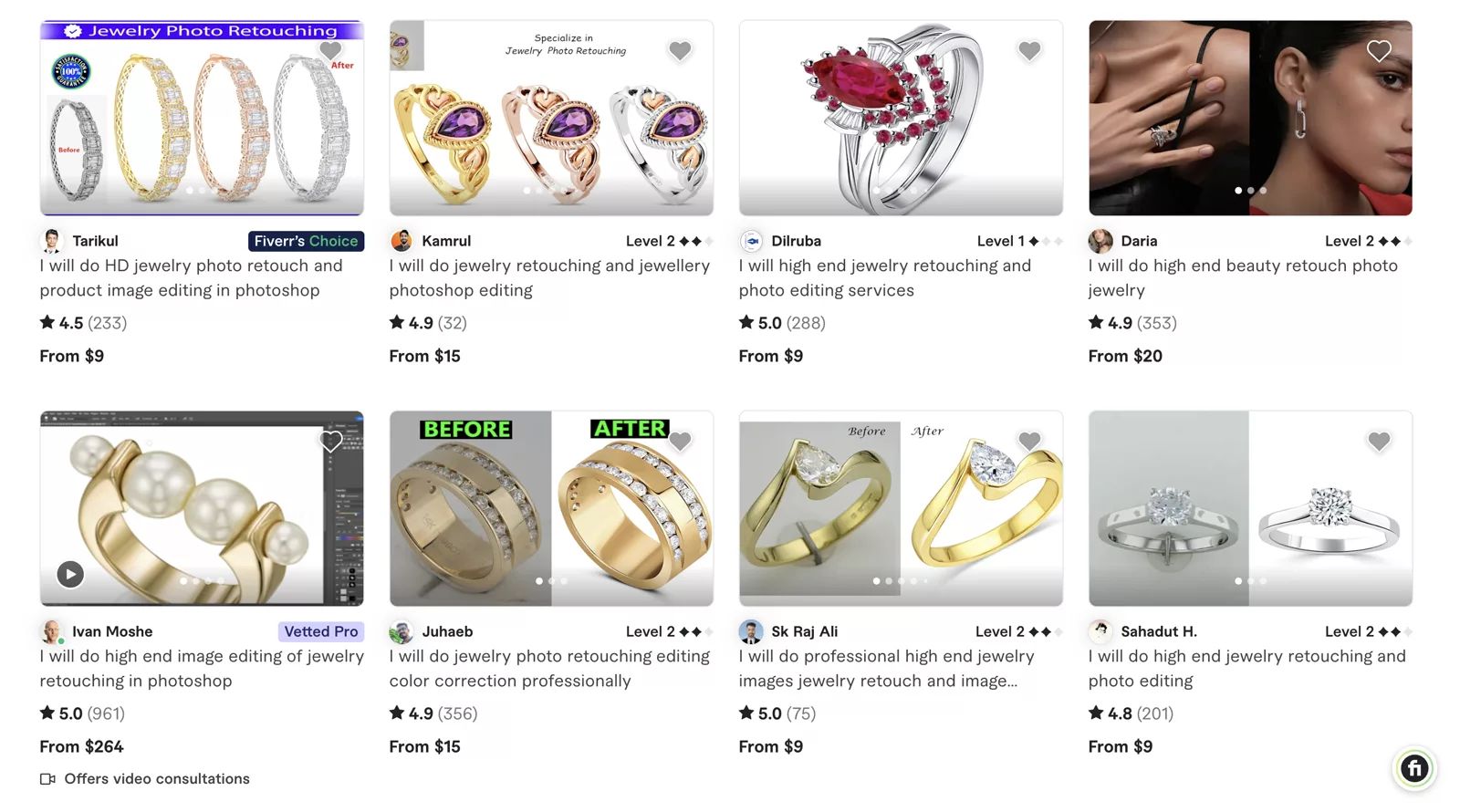
The portfolio is your single most reliable indicator of what a company can actually do. But not all portfolios tell the same story. Look for variety across jewelry types: rings, necklaces, watches, and loose stones each present different retouching demands, and a provider showing only one category may lack the range your catalog requires.
Before-and-after comparisons are essential. They show you the gap between the raw capture and the finished image, which reveals how much skill and judgment the retoucher brings to the table. A portfolio full of polished final images with no originals for context could mean the source photography was already excellent and the retouching was minimal, or it could mean the samples are cherry-picked. Either way, you are not learning much.
Consistency across images matters just as much as individual quality. Browse 10 or 15 samples in sequence. Do the metal tones match? Are shadows handled the same way? Does the color grading feel cohesive? A provider delivering jewelry image retouching services at a professional level will show catalog-scale uniformity, not just a handful of standout shots. Generic product retouching portfolios, even impressive ones, are not sufficient proof of jewelry capability. The technical demands are too different.
Turnaround Reliability and Revision Policies
Speed matters, but predictability matters more. Ask about standard delivery timelines for the batch sizes you typically send. Then ask about rush order capacity and what it costs. A company with structured workflows and clear timelines will give you specific answers, not vague assurances.
Revision policies deserve equal scrutiny. Find out how many revision rounds are included in the base price, what qualifies as a revision versus a new editing request, and how quickly revisions are turned around. Some providers include one round of minor corrections. Others charge per revision from the first change. If the policy is not documented anywhere on their site or in their service agreement, that ambiguity will cost you time and money once the project is underway. Look for clear SLAs that define delivery windows and outline what happens if deadlines are missed.
Pricing Transparency and Value Signals
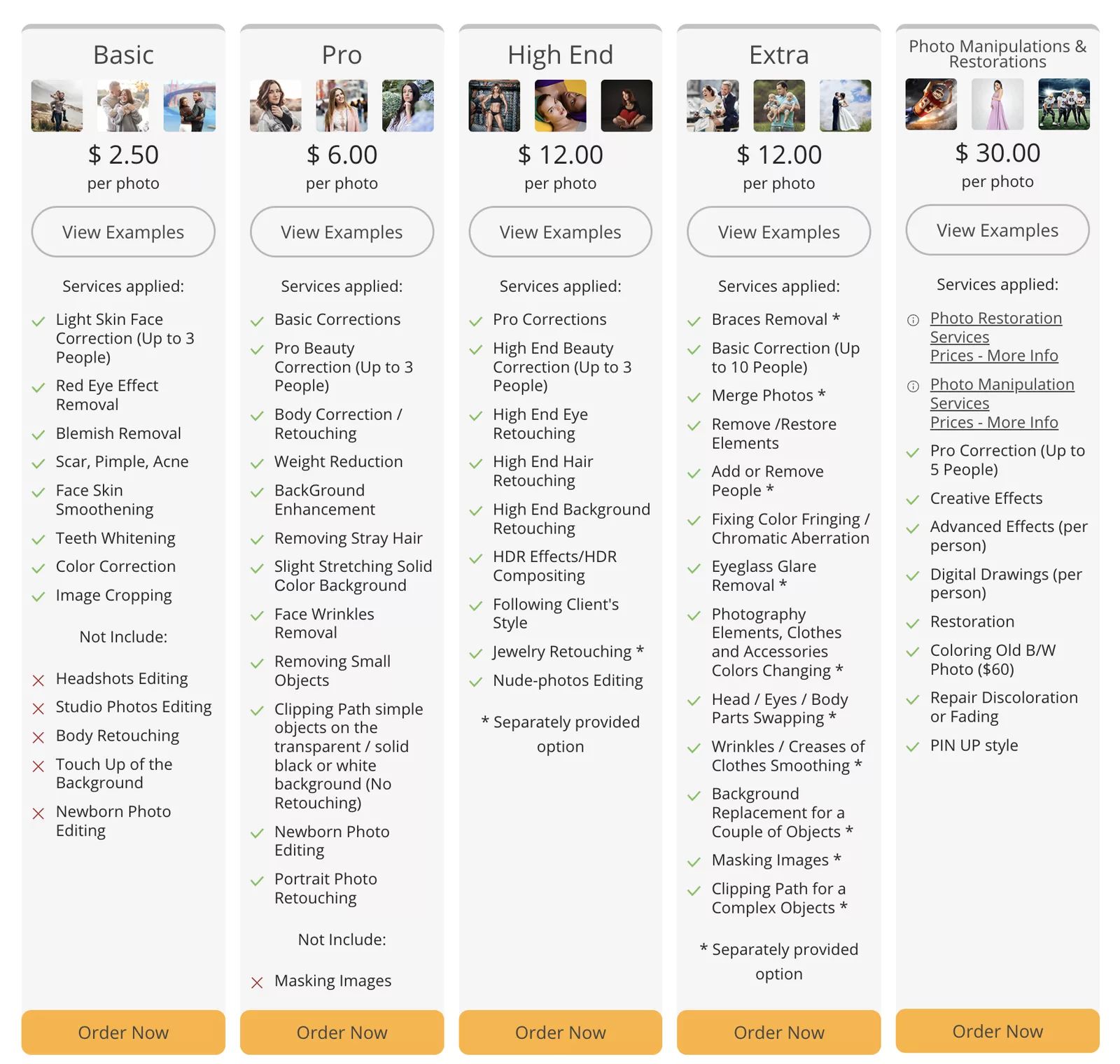
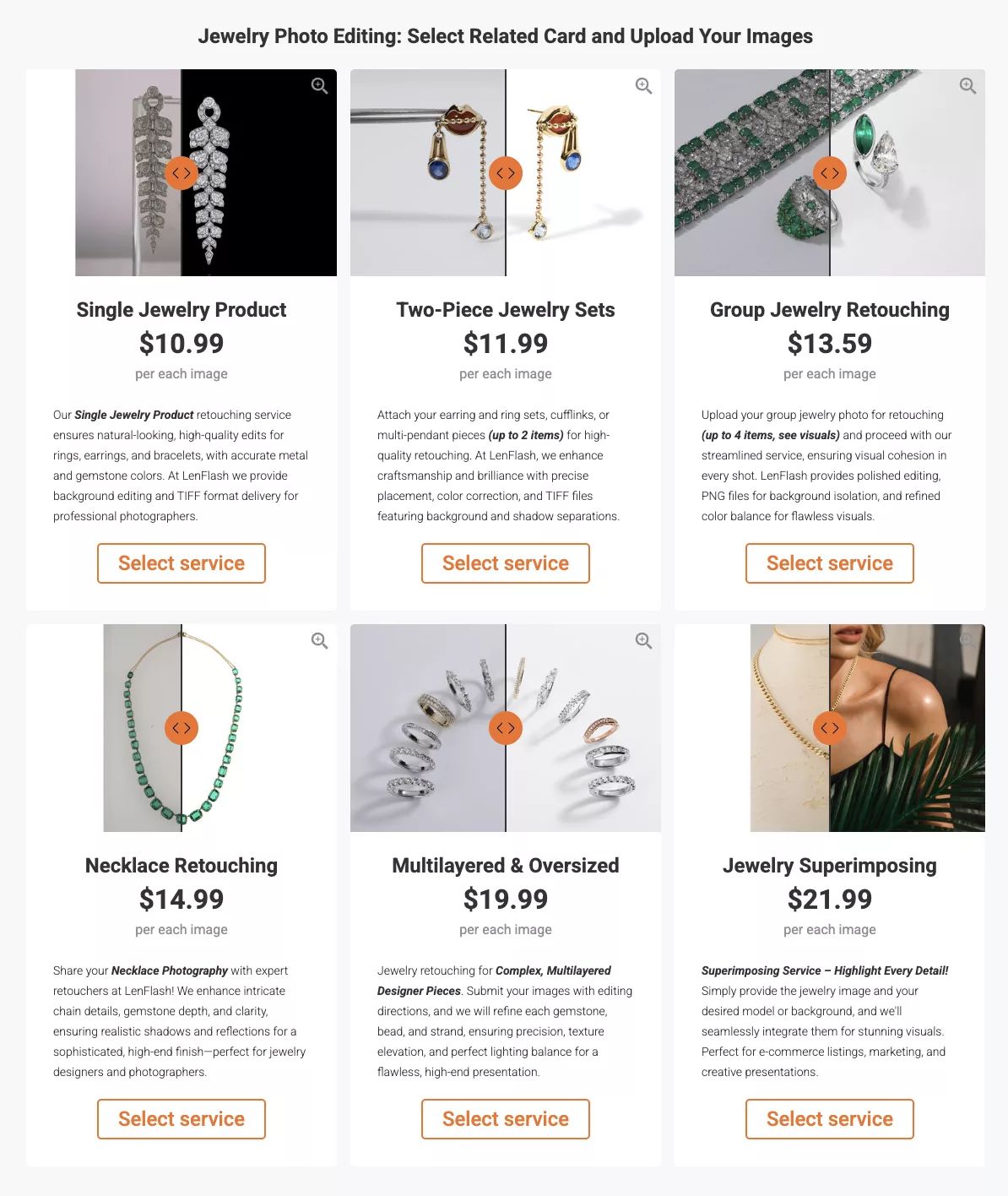
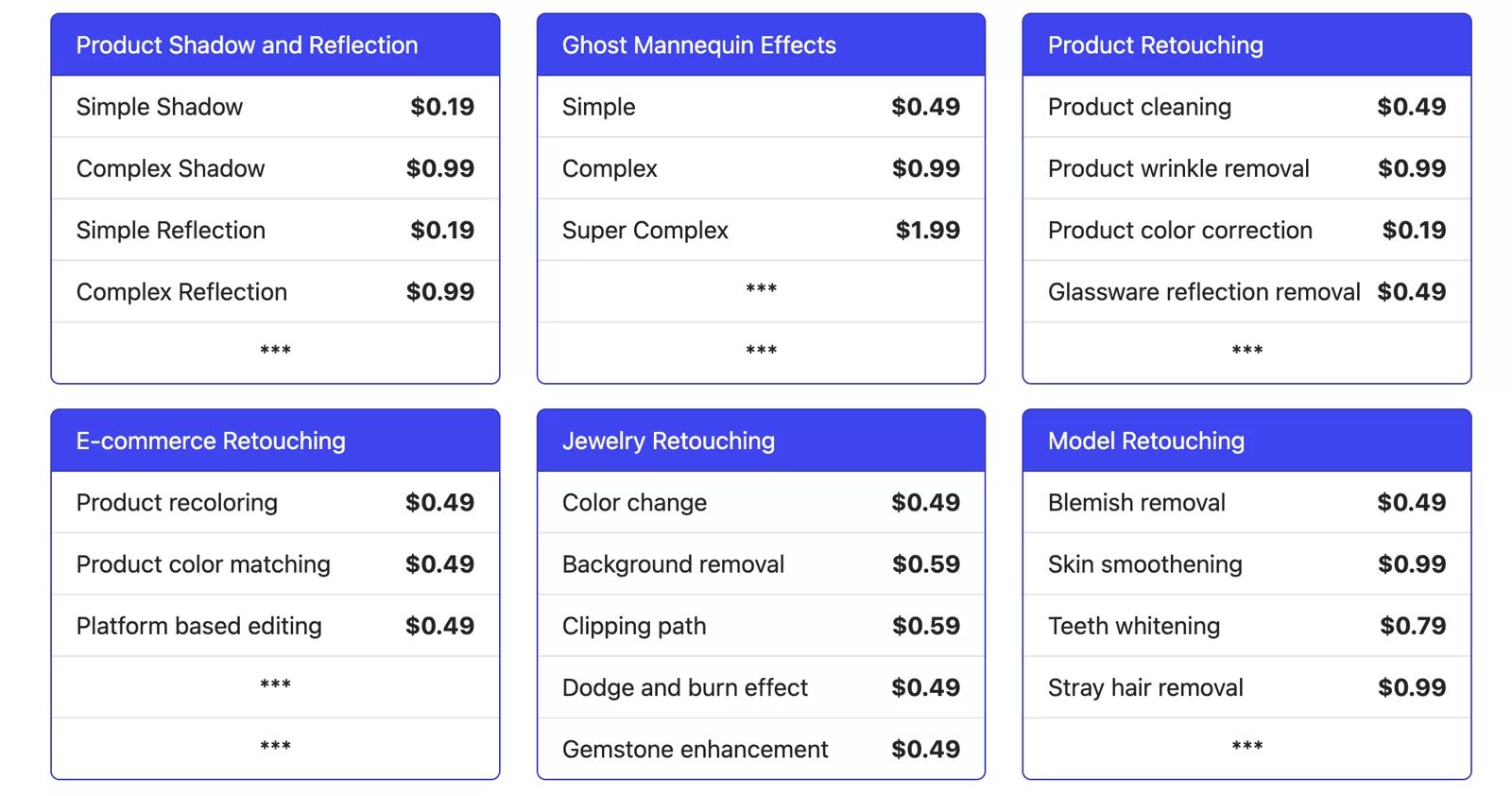
Pricing models for jewelry photography retouching vary widely. Some companies charge per image, others per batch or through monthly subscriptions, and many tier their rates by complexity level. Any of these structures can work, but the model should be clearly explained before you commit.
Be cautious with rates that seem dramatically lower than the market. Standard color correction across the broader photo editing industry ranges from $0.30 to $2.00 per photo, while high-end retouching can command $50 to $250 per finished frame. Jewelry-specific work, with its reflection cleanup, gemstone enhancement, and focus stacking demands, sits toward the higher end of that spectrum. A provider quoting rock-bottom rates for complex jewelry work is likely cutting corners through heavy automation with no human QA, undertrained editors, or a bait-and-switch model where the base rate covers only the simplest edits and every real retouching task is billed as an add-on.
The cheapest option is rarely the best value. Focus on what you get for the price: the level of retouching included, the revision policy, the turnaround commitment, and the consistency of output across a full batch. Those factors determine actual value far more than the per-image number alone.
Platform Compliance and File Delivery
If you sell on Amazon, Etsy, or Shopify, your images need to meet specific technical standards, and a professional retouching partner should know them without being told. Amazon requires a pure white background (RGB 255,255,255) with the product filling at least 85% of the frame, at a minimum of 1000 x 1000 pixels. Shopify recommends 2048 x 2048 pixels with consistent aspect ratios. Etsy calls for at least 2000 pixels on the shortest side.
Ask whether the company delivers files formatted for your specific sales channels, including correct resolution, file type (JPEG, PNG, TIFF), background treatment, and dimension requirements. A provider that proactively asks about your intended use, whether web, print, or marketplace, and delivers accordingly signals operational maturity. One that hands you a batch of files and leaves formatting to you is adding hidden work to your plate.
Your Step-by-Step Evaluation Checklist
When you are ready to vet a potential partner for outsource jewelry photo clipping services or full retouching work, follow this sequence to cover every critical dimension before signing anything.
- Define your requirements first. List the jewelry types you need retouched, your typical batch size, turnaround expectations, and the platforms where images will be used. This gives you a concrete brief to evaluate providers against.
- Request a jewelry-specific portfolio. Ask for before-and-after samples that match your product categories. If the provider cannot show relevant work, move on.
- Ask for a paid test edit. Send three to five representative images and pay for a trial batch. Evaluate the results for quality, consistency, color accuracy, and adherence to your instructions. A company confident in its work will welcome this.
- Review the revision and SLA policy in writing. Confirm how many revision rounds are included, what counts as a revision, response time commitments, and what happens if a deadline is missed.
- Compare pricing against scope, not just rate. Get itemized quotes from two or three shortlisted providers. Check what each rate includes and where add-on charges apply. The lowest number is meaningless without knowing what it covers.
- Verify platform compliance. Confirm the provider can deliver files meeting the exact specifications of your sales channels, including background, resolution, format, and dimension requirements.
- Test communication responsiveness. Pay attention to how quickly and clearly the company responds during the evaluation process. Slow or vague communication before you are a paying client rarely improves after you become one.
This checklist is not about finding a perfect provider. It is about filtering out the ones that cannot meet your actual needs before you invest time and money in a relationship that does not work. And some of the most telling signals are not what a company shows you, but what it fails to mention, which is exactly where the real red flags hide.
Red Flags That Signal an Unreliable Retouching Partner
The evaluation checklist above tells you what to look for. This section is about what should make you walk away. Not every warning sign is obvious. Some of the riskiest providers look perfectly professional on the surface, and the problems only emerge after you have paid a deposit or committed a batch of images. Knowing these red flags in advance saves you from learning them the expensive way.
Pricing That Seems Too Good to Be True
Jewelry is one of the most labor-intensive product categories to retouch. When a provider quotes rates dramatically below the market for retouching jewelry photos, something is being cut. As E-com Photos explains, cheap retouching services often employ inexperienced editors who cut corners to meet unrealistic deadlines, resulting in subpar work that fails to meet expectations.
In practice, rock-bottom pricing usually means one of three things: heavy automation with no human quality check, offshore teams without jewelry-specific training, or bait-and-switch structures where the advertised rate covers only basic edits like cropping and background removal, while every real retouching task, gemstone enhancement, reflection cleanup, color correction, is billed as an add-on. You request a retouch service at one price and end up paying double once the invoice arrives. If a company cannot explain how it delivers complex jewelry work at a fraction of what competitors charge, the explanation is almost always in the quality.
No Jewelry-Specific Portfolio or Vague Samples
You would not hire a wedding photographer based on their landscape portfolio. The same logic applies here. A provider showing only general product photos, heavily watermarked thumbnails, or a handful of polished finals with no before-and-after comparisons may lack genuine experience with jewellery photo editing services.
Watch for portfolios that feature one or two impressive ring shots surrounded by handbags, electronics, and apparel. That spread suggests jewelry is a sideline, not a specialty. Also be skeptical of samples that look pulled from stock libraries or other companies' websites. Ask for raw-to-final pairs on pieces similar to yours. If the provider hesitates or cannot produce them, that silence tells you more than any sales pitch would.
Missing Revision Policy or Unclear Communication
Revisions are a normal part of any retouching relationship. The problem starts when a company does not define how they work. How many rounds are included? What counts as a revision versus a new request? What is the expected response time? If these answers are not documented anywhere, you are walking into a situation where every correction becomes a negotiation.
Communication patterns during the sales process are a reliable preview of what happens after you commit. Fstoppers notes that response time inconsistencies, including delayed replies, missed meetings, and vague answers to reasonable questions, are among the most common red flags clients encounter, and these patterns rarely improve once money changes hands. If a provider is slow to respond, unclear in their explanations, or evasive about process details before you are a paying client, expect worse once the urgency of winning your business disappears.
No Discussion of File Specifications or Delivery Standards
A professional retouching partner should ask about your intended use before starting work. Will images go on Amazon, Etsy, Shopify, or into a print catalog? Each channel has different requirements for resolution, background, file format, and dimensions. A company that never raises these questions is either unfamiliar with marketplace standards or planning to deliver a one-size-fits-all output and leave the formatting to you.
This gap is especially costly for sellers working with jewelry product photography experts in competitive markets like Los Angeles, New York, or other major ecommerce hubs, where image standards are high and platform compliance is non-negotiable. Receiving a batch of beautifully retouched files that do not meet your marketplace specs means rework, delays, and potentially missed listing deadlines. The retouching itself might be fine, but if the delivery is not production-ready, you are paying twice for the same job.
Quick-Reference Red Flag Checklist
Keep this list handy when evaluating any potential retouching partner. A single flag is worth a conversation. Multiple flags are a reason to move on.
- Per-image rates far below market average with no clear explanation of how quality is maintained at that price point.
- No jewelry-specific before-and-after samples in the portfolio, or samples limited to a single jewelry type that does not match your product mix.
- Vague or undocumented revision policy with no written terms on included rounds, turnaround for corrections, or what constitutes a new request versus a revision.
- Slow or inconsistent communication during the inquiry and quoting phase, especially delayed responses, missed follow-ups, or generic replies that do not address your specific questions.
- No questions about your delivery requirements, including target platform, file format, resolution, background specifications, or intended use of the final images.
- Resistance to a paid test edit, a confident provider welcomes a trial batch because it demonstrates capability rather than hiding it.
- No clear point of contact or project management process, leaving you unsure who to reach when issues arise or how feedback is routed to the editing team.
These warning signs are not about being overly cautious. They are about recognizing the patterns that consistently predict frustration, wasted budget, and images that do not meet your standards. The good news is that avoiding these pitfalls is straightforward once you know what to watch for, and the next step is making sure the relationship you do choose is set up to succeed from the very first brief.

Getting the Best Results From Your Jewelry Retouching Partner
Spotting red flags keeps you out of bad partnerships. But avoiding the wrong provider is only half the equation. The other half is setting the right provider up to do their best work for you. Even a highly skilled retouching team will underdeliver if the brief is vague, the feedback is scattered, or the relationship never evolves past one-off transactions. The difference between adequate results and consistently outstanding output almost always comes down to how well you communicate, not just how talented the retoucher is.
This is where most jewelry brands leave value on the table. They invest time vetting retouching companies, negotiate pricing, send a batch of images, and then wonder why the results do not quite match what they had in mind. The missing piece is almost always on the briefing and feedback side, and fixing it costs nothing but a little upfront structure.
How to Write an Effective Retouching Brief
Your jewelry retouching brief is the single document that determines whether a project starts smoothly or spirals into revision after revision. Think of it as a contract between your creative vision and the retoucher's technical execution. The more specific it is, the fewer rounds of back-and-forth you will need.
A strong brief includes these elements:
- Reference images showing your desired style. Pull two or three finished images that represent the look you want, whether from your own past work, competitor sites, or mood boards. Visual references communicate tone, shadow style, and color mood far more efficiently than written descriptions alone.
- Specific instructions per jewelry type. A ring brief and a necklace brief should not be identical. Specify whether you want prong detail sharpened, chain links individually cleaned, or gemstone saturation pushed slightly warmer. The retouching priorities differ by category, and your brief should reflect that.
- Background preferences. Pure white for Amazon? Light gray gradient for your website? Lifestyle composite for social media? State the background treatment for each intended use so the retoucher delivers the right version without guessing.
- Color targets for metals and stones. If your rose gold should lean warm pink rather than copper, say so. If your sapphires should read as a deep royal blue rather than a violet-tinged hue, include a color swatch or reference photo. As Pixelz's retouching experts note, the more information you provide, the better a retoucher can dial in your brand's needs, and the smoother future projects will run.
- Marketplace compliance requirements. List the platforms where images will be used and their specific file specs: resolution, dimensions, file format, and background standards. A professional partner should already know these, but confirming them in writing eliminates assumptions.
Investing 30 minutes in a thorough jewelry retouching brief saves hours of revision time across every batch you send. It also gives your retouching partner a concrete standard to measure their own output against, which makes quality control easier on both sides.
Giving Feedback That Gets Results
Even with a detailed brief, the first batch from a new partner will rarely be perfect. That is normal. What matters is how you handle the gap between what you received and what you expected. Vague feedback like "the ring looks off" or "make it pop more" forces the retoucher to guess, and guessing leads to more revisions, not fewer.
Structured feedback follows a simple pattern. Use annotated screenshots to point out exactly what needs to change, circling the specific area on the image rather than describing it in words. Number each revision request so nothing gets lost in a long email thread. And use consistent terminology: if you call it "reflection cleanup" in one message, do not switch to "shine removal" in the next. Retouching companies that handle dozens of clients simultaneously rely on clear, unambiguous language to route corrections to the right editor without confusion.
A practical approach from collaborative workflow research reinforces this: establish clear guidelines before the project begins about how feedback will be given, the channels used for communication, and the timeline for revisions. When every stakeholder is aligned on the process, corrections become efficient exchanges rather than frustrating negotiations.
One more thing worth remembering: feedback is a two-way street. A good retouching partner will ask clarifying questions, push back when a request might compromise image quality, and suggest alternatives you had not considered. Welcome that input. The best jewelry retouching workflow is a conversation, not a set of one-directional instructions.
Building a Long-Term Retouching Workflow
The first few batches with any new partner are an investment. You are teaching them your brand's visual language, and they are learning your preferences, your product mix, and your quality bar. This learning curve is unavoidable, but it flattens quickly if you build the right systems around it.
Start with a retouching style guide. This is a living document that captures everything your partner needs to know: preferred shadow style, metal tone targets, gemstone saturation levels, background treatments by platform, cropping rules, and output specifications. Pixelz describes a style guide as the GPS instructions to the final destination of image editing, giving retouchers both the technical detail and the brand understanding to produce consistent work without constant oversight. Once your guide is in place, onboarding new editors or scaling to a larger team becomes dramatically easier.
Next, establish batch processing routines. Agree on a regular submission schedule, whether that is weekly, biweekly, or tied to your product launch calendar. Consistent cadence helps your partner allocate resources, which improves turnaround reliability. It also lets you plan your own marketing and listing timelines around predictable delivery dates rather than ad hoc requests.
Set quality benchmarks early. Pick five to ten finished images that represent your gold standard and share them as permanent reference points. When a new batch arrives, compare it against those benchmarks before approving. Over time, the gap between what you receive and what you expect should narrow to near zero. If it does not, that is a signal to revisit the brief or reconsider the partnership.
The best outsourcing relationships evolve from transactional per-image work into strategic partnerships where the retouching company understands your brand's visual identity as deeply as your own team does. At that stage, you spend less time briefing, less time reviewing, and more time focused on growing your business. For brands ready to explore a partner built around jewelry image clarity, shine, and consistency at scale, Snappyit's Jewelry Retouch offers a service designed specifically for ecommerce jewelry imagery, making it a logical starting point for sellers who have absorbed the evaluation guidance in this article and want to put it into practice.
The quality of your retouched jewelry images is never just about the retoucher's skill. It is equally about the clarity of your brief, the precision of your feedback, and the systems you build to make the relationship better with every batch.
Jewelry retouching is not a commodity you purchase and forget about. It is an ongoing collaboration that directly shapes how customers perceive your brand, your products, and your attention to detail. The companies that get the best results are not necessarily the ones spending the most per image. They are the ones who invest in communication, build repeatable systems, and treat their retouching partner as an extension of their creative team rather than a vendor to be managed at arm's length. Start with a clear brief, give feedback that a retoucher can act on, and build toward a workflow that improves with every project. That is how you turn a retouching expense into a competitive advantage.
Frequently Asked Questions
1. How much does professional jewelry retouching cost per image?
Jewelry retouching costs vary widely depending on the approach. AI-only processing ranges from $0.90 to $2.00 per image and works well for high-volume catalog listings. Hybrid workflows combining AI with human refinement typically cost $2.00 to $10.00 per image, offering a balance of quality and efficiency. Fully manual retouching from skilled specialists runs $5.00 to $25.00 or more per image for freelancers, and $25 to $200+ per frame at studio level for luxury advertising work. The right price point depends on your quality requirements, image volume, and whether you need advanced techniques like focus stacking or gemstone brilliance enhancement.
2. What is the difference between jewelry retouching and regular product photo editing?
Jewelry retouching is significantly more complex than standard product editing due to five key challenges: managing reflections on curved polished metal surfaces, assembling focus-stacked composites from multiple macro exposures, correcting microscopic flaws invisible to the naked eye, reproducing precise gemstone and metal colors, and enhancing light transmission through translucent stones. General product retouchers rarely encounter these demands at the same intensity, which is why specialized jewelry retouching companies invest in calibrated monitors, gemstone color knowledge, and retouchers trained specifically in handling precious metals and stones.
3. Should I outsource jewelry retouching or keep it in-house?
The decision depends on your monthly image volume, budget structure, turnaround needs, and internal expertise. In-house retouching works best when volume is under 50 images per month, you need same-day turnaround, or your creative direction requires constant real-time oversight. Outsourcing delivers better value at 200+ images per month, when you lack jewelry-specific retouching skills internally, or when you prefer variable per-image pricing over fixed salary costs. Many growing brands adopt a hybrid model, keeping hero shots and urgent work in-house while routing catalog-scale batches to a specialized partner like Snappyit's Jewelry Retouch service (https://snappyit.ai/jewelry-retouch) for consistent, scalable output.
4. What red flags should I watch for when choosing a jewelry retouching company?
The most telling warning signs include per-image rates far below market average with no explanation of how quality is maintained, portfolios lacking jewelry-specific before-and-after samples, undocumented revision policies, slow or inconsistent communication during the inquiry phase, no questions about your delivery specifications or target platforms, and resistance to completing a paid test edit. Multiple flags appearing together strongly suggest the provider will underdeliver on complex jewelry work. A reliable partner will proactively ask about your marketplace requirements, offer trial batches, and clearly document their revision terms and turnaround commitments.
5. How do I write an effective brief for my jewelry retouching partner?
An effective jewelry retouching brief includes five core elements: reference images showing your desired visual style, specific instructions tailored to each jewelry type in your catalog, background preferences for each sales channel, color targets for metals and gemstones with swatches or reference photos, and marketplace compliance requirements listing resolution, dimensions, file format, and background standards. Investing time in a thorough brief reduces revision rounds, speeds up delivery, and gives your retouching partner a measurable standard to work against. Over time, this brief evolves into a full retouching style guide that ensures consistency across every batch.
Generate your first results in 90 seconds
Skip the manual grind for 80% of your catalog. Run a flat-lay or supplier photo through Snappyit AI Jewelry Retouch and ship listing-ready imagery in under two minutes — free to try, no credit card.
Try Snappyit AI Jewelry Retouch free →