What to sell — five jewelry categories, and how online buyers behave differently
The single biggest mistake people make when they start to sell jewelry online is treating "jewelry" as one market. It isn't. The buyer for a $24 birthstone necklace on Etsy has nothing in common with the buyer for a $4,800 estate sapphire ring on Ruby Lane. Different audience, different price psychology, different photography, different platform. Pick which category you're selling jewelry online in before you pick a platform.
| Category | Typical AOV | Where buyers shop | What sells |
|---|---|---|---|
| Handmade / personalized | $15–$80 | Etsy, Amazon Handmade, Instagram | Name necklaces, birthstones, custom-engraved rings, friendship sets |
| Fashion / minimalist | $25–$150 | Shopify, Instagram, TikTok Shop | Gold-vermeil and silver everyday pieces, layering chains, hoop earrings |
| Fine / demi-fine | $200–$2,000 | Shopify, dedicated DTC sites | 14k–18k gold, real diamond, lab-grown gemstones, bridal-adjacent |
| Vintage / estate | $80–$5,000+ | Ruby Lane, eBay, Etsy vintage, 1stDibs | Signed designer (Tiffany, Cartier, Van Cleef), Victorian, mid-century |
| Bridal | $500–$10,000+ | Shopify, Brilliant Earth-style DTC, Etsy custom | Engagement rings, wedding bands, bridesmaid sets |
The most common mistake new jewelry sellers make is choosing the wrong category for the platform. Bridal pieces don't sell on Poshmark. Vintage estate doesn't sell on Amazon. Personalized handmade gets buried on Ruby Lane. Match the category to the platform.
Where to sell — platform-by-platform breakdown
Etsy — the default for handmade and personalized
Etsy remains the largest dedicated handmade and personalized jewelry marketplace in 2026. Built-in audience of 90M+ buyers actively searching for "name necklace," "birthstone ring," "anniversary gift" — long-tail keywords that drive jewelry purchases. Fees: 6.5% transaction + $0.20 listing fee + payment processing (3% + $0.25 US). Use the Etsy fee calculator to confirm margin per SKU. Best photo strategy: white-background main image + lifestyle on-model secondary slots.
Amazon Handmade — second channel after Etsy
Amazon Handmade is the natural second channel for handmade jewelry sellers who have process down on Etsy. Requires application + makers verification. Lower listing volume per seller than Etsy but the buyers are higher-intent. Fee: 15% referral fee on jewelry. No monthly fee for Pro Merchant if under 40 items/month.
Shopify — own your brand, own the customer
Shopify is the right move once you have a repeat-buyer pattern and want full pricing and branding control. Cost: $39+/month for Basic plan, 2.9% + $0.30 payment processing. No marketplace cut on direct sales, but you need to drive your own traffic — paid social, SEO, email, influencer. Best for fashion, fine, and bridal categories.
eBay — vintage, estate, signed designer
eBay's Cassini search ranking and auction format make it the right home for vintage and estate jewelry with collector demand. Fees: ~13.6% final-value fee on jewelry + $0.35 insertion fee after 250 free listings. Use the eBay fee calculator for per-piece margin.
Ruby Lane — collector-grade vintage and antique
Ruby Lane attracts a more curated, older, higher-budget collector audience than eBay. Lower listing volume but higher AOV. Best for signed-designer estate, Georgian and Victorian, mid-century, and antique fine jewelry. Monthly maintenance fee + 9.9% transaction fee.
Poshmark and Mercari — fashion jewelry resale
These work for under-$80 fashion jewelry being resold or destashed, not for original handmade or fine pieces. Buyers are price-conscious and brand-aware (Madewell, Mejuri, Pandora resell well). Poshmark: $2.95 flat under $15, 20% above. Mercari: ~10% sale fee.
Instagram and TikTok Shop — content-led discovery
Instagram Shopping and TikTok Shop are not destination marketplaces — they're content engines that convert. Use them as supplementary channels once you have a Shopify store, not as standalone. The content is the product; the checkout is just the closing step.
Source or make — what to actually put in your shop
The four paths to jewelry inventory:
- Make it yourself. Wirework, beading, polymer clay, lost-wax casting, hand-set stones. Lowest unit cost, highest labor cost, full creative control. Best for handmade-personalized category.
- Drop-ship from a fine-jewelry partner. Companies like Gemnotes, Vrai, or wholesale-direct programs (RealJewelers, JTV wholesale) let you list pieces and ship from their warehouse. Lower margins, faster catalog scale.
- Private-label from a manufacturer. Alibaba and India-based jewelry manufacturers will produce custom designs with your branding. Best for fashion and demi-fine categories at $25–$200 AOV. MOQ usually 50–100 pieces per design.
- Buy and resell. Estate sales, auctions, signed-designer marketplaces (1stDibs, The RealReal, Worthy) — buy below market, resell at margin on eBay or Ruby Lane.
Whichever path you pick, never list a piece you haven't held physically. Photos of supplier samples lie constantly — the metal plating chips, the stones are cloudy, the chain is thinner than the listing suggests.
Photography — the bottleneck that kills most jewelry shops
Jewelry photography is brutal. A single ring shot traditionally requires polarized lighting, a clean white sweep, dust-free macro focus, hand model booking, color-accurate calibration, and 20–40 minutes of retouching per frame. For a 50-piece launch collection, that's 25–40 hours of studio work plus a $400–$800 retoucher invoice.
For most new jewelry sellers, this is the step that doesn't ship. The pieces look great in person. The phone snaps look terrible. The listings convert at 0.5%.
The 2026 workflow that actually ships:
- Shoot a clean source photo. Lay the piece on a neutral surface (white or light grey), top-down, in even daylight (window with diffuser or a $30 LED softbox). Phone camera is fine. Get the piece in focus; ignore dust, reflections, color cast — those get cleaned in step 2.
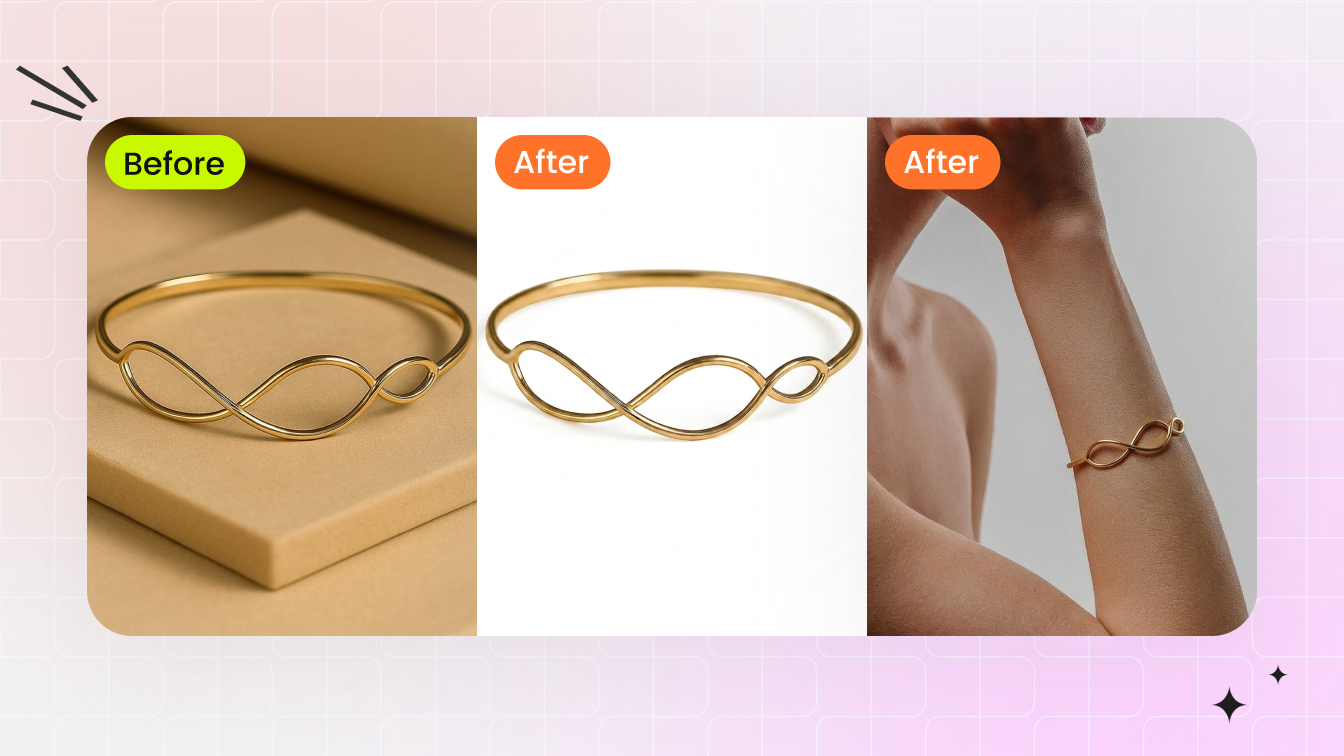
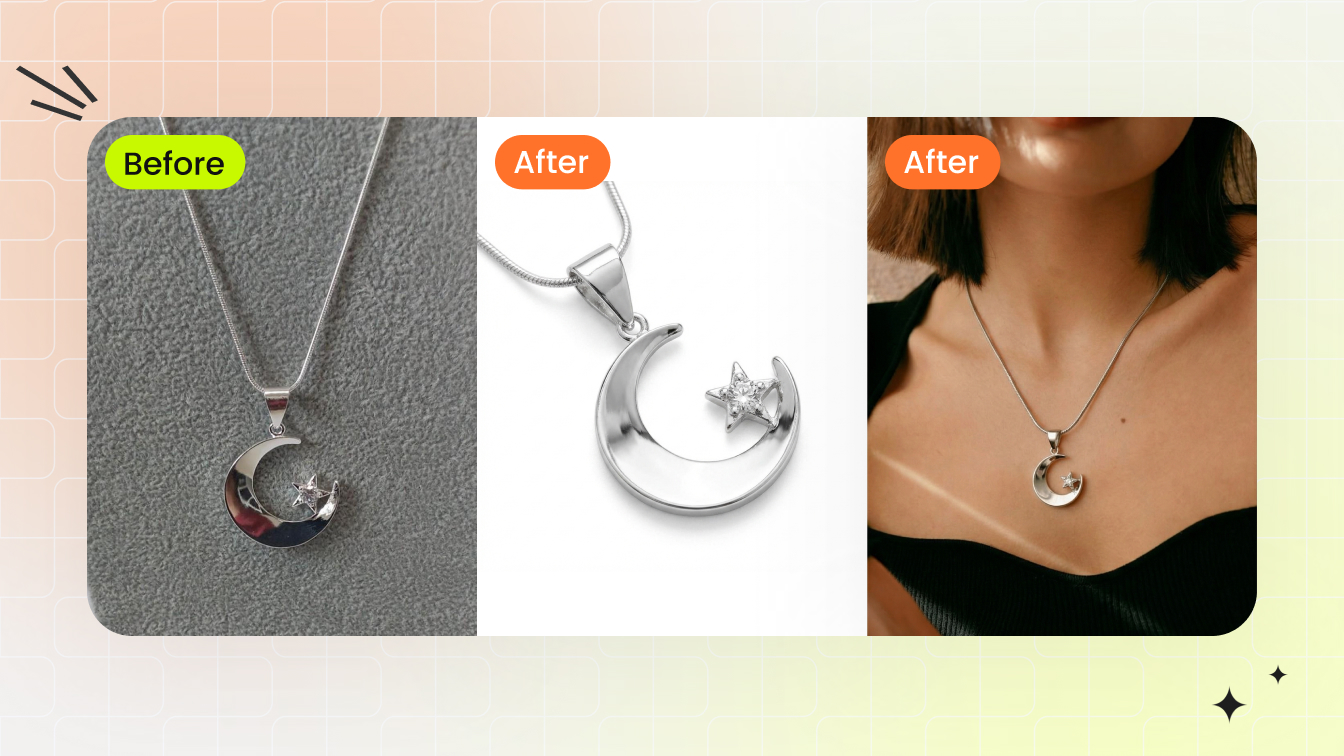
- Run AI Jewelry Retouch. Snappyit Jewelry Retouch removes dust, fingerprints, supplier backdrops, and corrects metal/stone color in 60 seconds. Output is a clean white-background catalog image ready for any marketplace main slot.
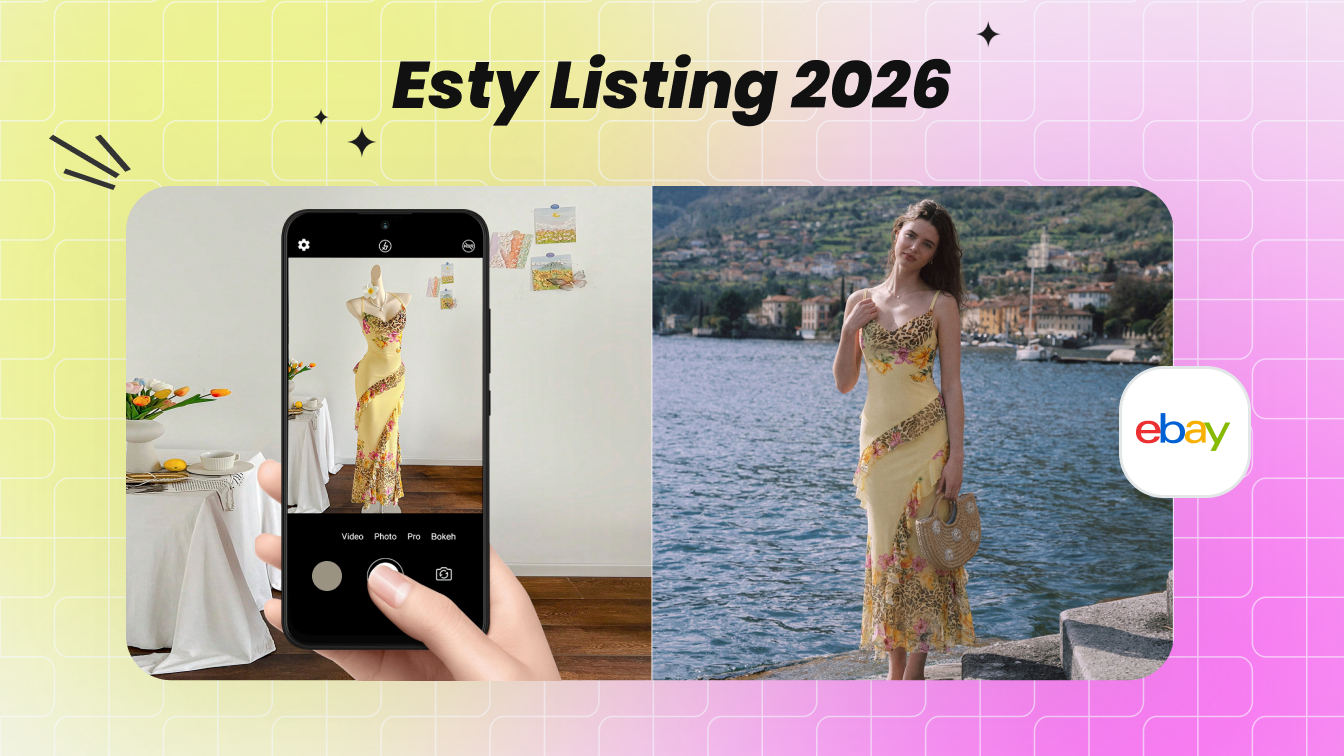
- Run AI Jewelry Model for the lifestyle shot. Snappyit Jewelry Model places the same piece on a hand template (rings), ear template (earrings), or neck template (necklaces) at natural scale. No hand model to book.
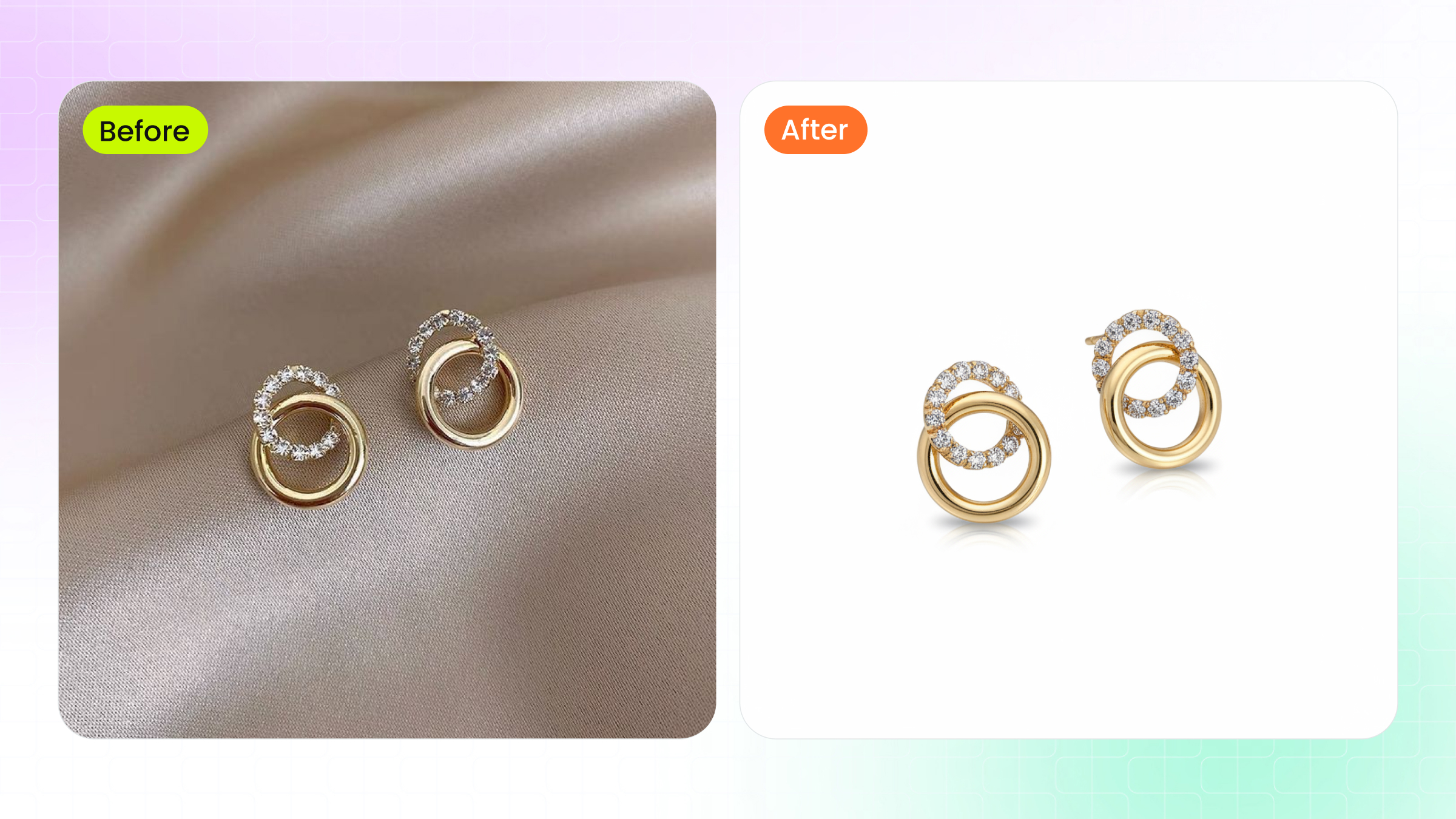
Total cost: under $5 per piece. Total time: 5 minutes per piece end-to-end. Compared to traditional studio + hand model + retoucher: roughly 95% cost reduction, 90% time reduction.
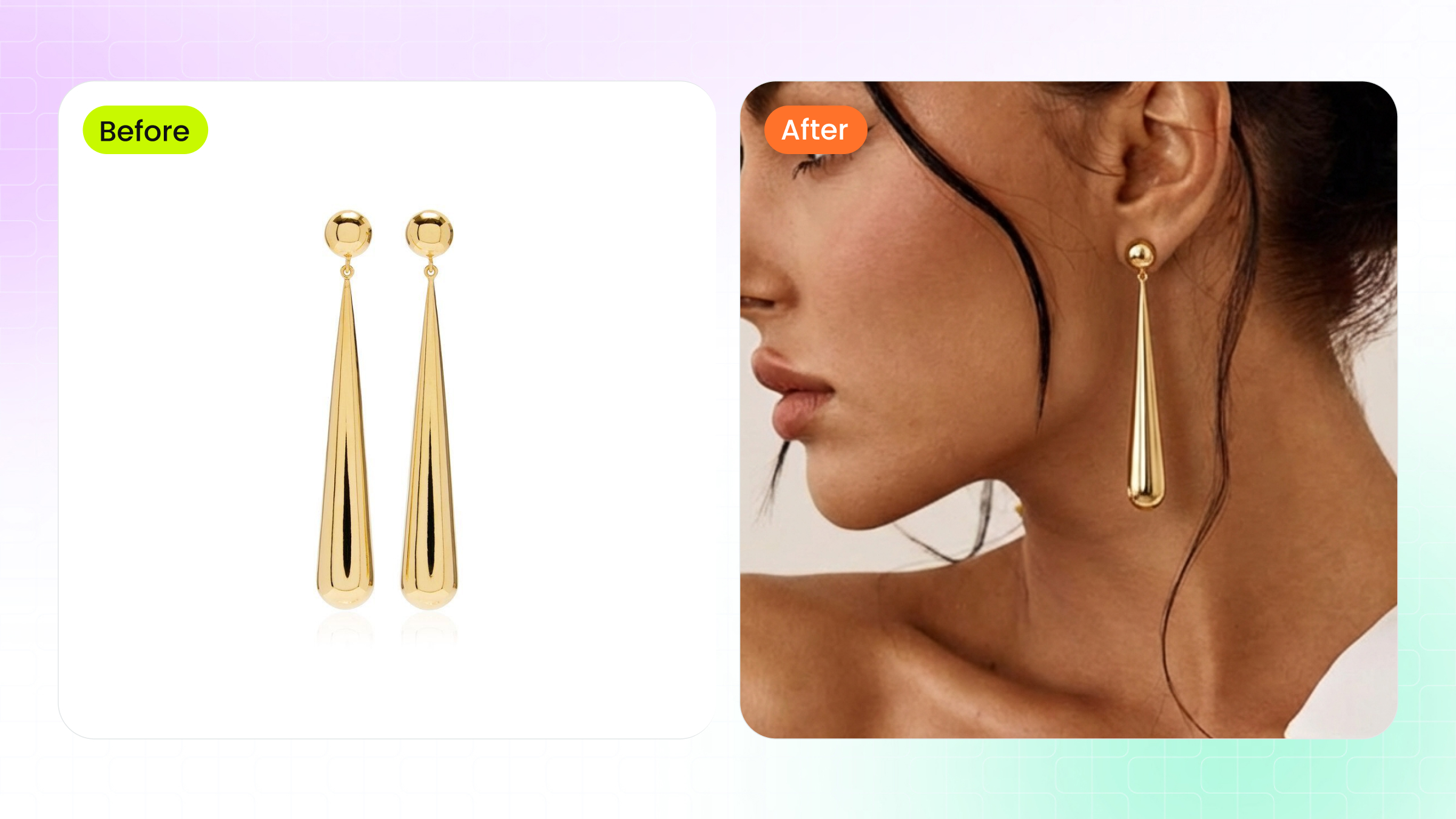
Try it on your hardest piece first. A ring with reflective metal and a small stone is the worst-case for traditional photography — and the test where AI workflows save the most time. Try Snappyit Jewelry Retouch free →
Pricing — the formula that survives platform fees and returns
The standard handmade-jewelry pricing formula:
Retail price = (Materials + Labor + Overhead) × 4
Wholesale price = (Materials + Labor + Overhead) × 2
Where labor is your time valued at $20–$30/hour (yes, even if you're solo — your time is real cost) and overhead is rent, tools amortization, shipping supplies, and platform subscription.
The 4x retail multiplier looks aggressive until you subtract everything that eats it:
- Platform fees: 6.5–17% (Etsy, eBay, Amazon, Shopify+payment)
- Marketing acquisition cost: 15–25% of revenue once you scale
- Returns and damages: 3–8% in jewelry
- Tax and accounting: 10–20%
- Founder labor (for solo sellers, this is the rest)
What's left of a 4x retail price after all the cuts is roughly 25–35% gross margin, which is the floor for a business that grows. Below 4x, you make pieces and lose money slowly. Above 4x, the price needs to justify itself with branding, photography, and design uniqueness — and that's where AI photography and strong listing copy earn their keep.
Listings that actually convert
Jewelry listings live or die on six elements. Get all six right and you outperform 90% of competitor shops.
- Main image — clean white background, piece centered, 1:1 ratio, 2000px+ on the long edge. This is the search-results thumbnail; if it doesn't pop at 200px, it doesn't get clicked.
- Lifestyle / on-model image — ring on a hand, earring on an ear, necklace on a neck. Adds scale context that the white-background image alone can't deliver. Lift add-to-cart by 30–60%.
- Detail / macro image — show the clasp, stone setting, engraving, hallmark. Builds trust.
- Scale reference — image with a ruler, a coin, or a hand for size comparison. Reduces returns by 40%+ in jewelry.
- Title with three concrete details — material + style + occasion. Example: "14k Gold Vermeil Birthstone Necklace — November Citrine — Birthday Gift" beats "Gold Necklace."
- Description with materials, dimensions, and care — chain length, ring size range, metal purity, gemstone weight/cut, allergen disclosures (nickel-free, hypoallergenic), care instructions. Buyers read this.
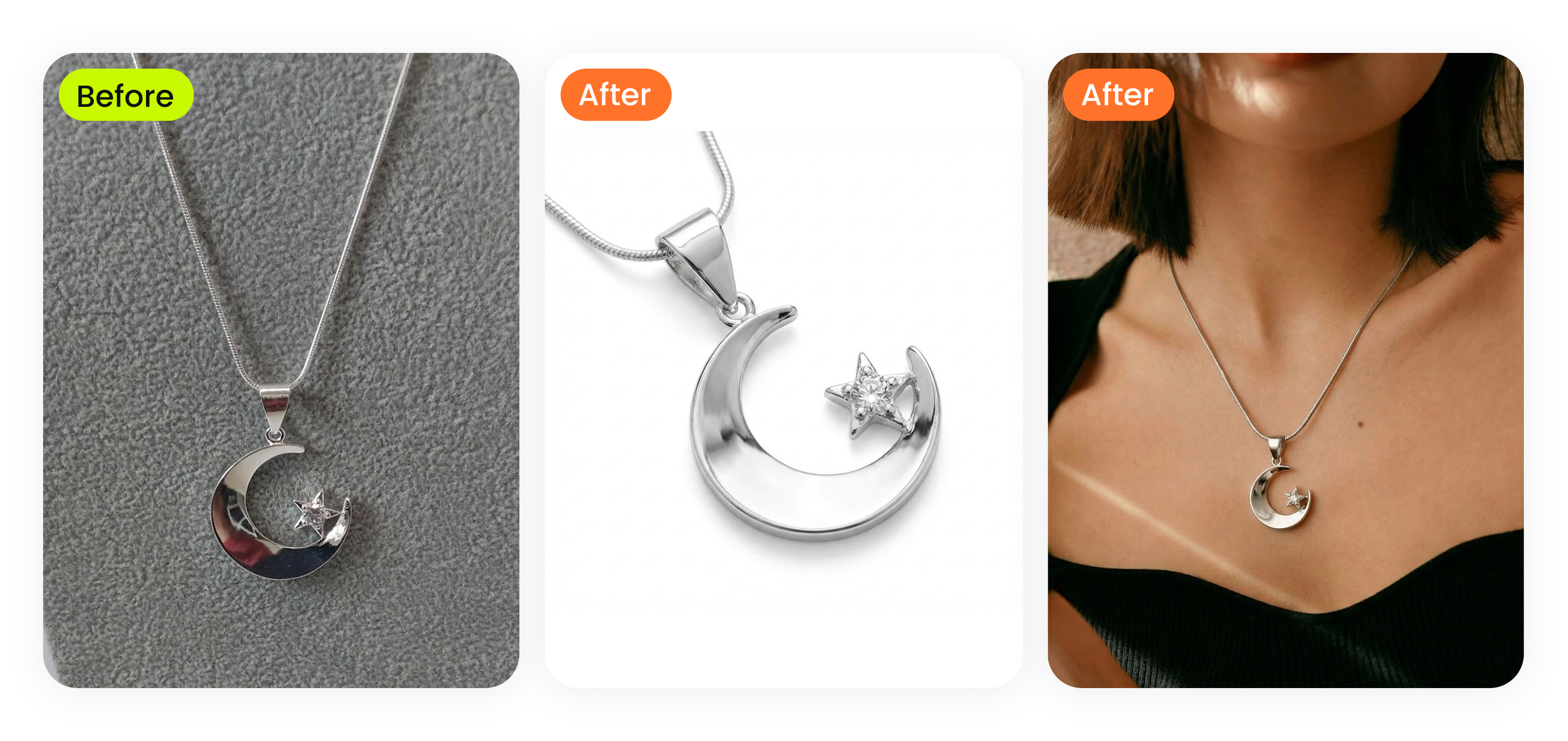
Photo styles by jewelry category — what to shoot, what to skip
When you sell jewelry online, the photo style that converts on a $24 handmade earring is not the photo style that converts on a $2,400 estate ring. The category sets the visual language, and getting it wrong leaves money on the table even if the listing copy and pricing are correct.
Handmade / personalized jewelry
Buyers shopping for personalized pieces want to see the piece in context — on a hand, on a neck, beside the recipient's photo. They convert on warmth, not clinical precision. Recommended shot order: 1) white-background main image, 2) on-model render (AI Jewelry Model is the fastest path), 3) detail shot showing the engraving or stamp, 4) styling/lifestyle shot showing the piece in everyday wear, 5) packaging shot — the gift box or pouch the buyer will actually receive.
Fashion / minimalist everyday jewelry
Sleek and editorial wins this category. Snappyit's AI Fashion Model template gallery includes layered minimal-jewelry templates that show your earring, ring, or pendant as part of a styled look. Pair with a white-background main image and a single detail macro showing material grain. Most fashion jewelry stores selling jewelry online overspend on lifestyle and underspend on the clean catalog shot — the white-background image is the search-results thumbnail, and that's the one that earns the click.
Fine and demi-fine jewelry
This is the category where retouching matters most. Polished gold and platinum surfaces act as mirrors that capture every studio reflection, dust speck, and color cast. Snappyit Jewelry Retouch cleans these in one pass; competing tools take 15–30 minutes per stone. Required shots: white-background main, on-hand or on-neck try-on, side-angle macro showing prong setting / clasp construction, and a hallmark close-up to back up the metal purity claim in the listing copy.
Vintage and estate jewelry
Patina, provenance, condition — these are the differentiators. Don't over-clean the piece in retouching; vintage buyers want to see honest wear marks that prove the piece is genuinely period. Required shots: 1) full piece on a neutral surface, 2) clasp / hallmark / signature close-up, 3) any provenance documentation, 4) sizing reference. Skip the AI on-model render here — collectors want the piece in their hand, not on a stranger's neck.
Bridal jewelry
Engagement rings and wedding bands convert on emotion plus trust. Buyers are spending $1,000–$10,000+ and they want to see every angle, every facet, every stone-to-band proportion. Required shots: white-background main, top-down ring shot, side-profile, on-hand try-on (this is where Snappyit Jewelry Model earns its keep — you can show the ring on six different hand templates without booking models), 3-stone or 5-stone close-up for engagement rings, packaging shot. Bridal sellers who skip on-hand shots see add-to-cart rates drop by 30–50 percent.
Compliance and trust signals for online jewelry buyers
Jewelry is a category where buyers are more skeptical than they are for clothing, electronics, or home goods. The piece is small, the price is high, and the difference between authentic and counterfeit is often invisible in a photo. Trust signals do real work — get them right and your conversion rate jumps 20–40 percent overnight.
Material claims that hold up to FTC scrutiny
The US Federal Trade Commission's Jewelry Guides set the rules for what you can claim. "Gold" without qualification implies solid gold throughout — if the piece is gold-plated or gold-filled, you must say so. "Sterling silver" requires .925 purity stamp. "Diamond" must be a natural diamond — lab-grown must be disclosed as "lab-grown diamond" or "synthetic diamond." Misrepresenting any of these is a regulatory violation and a one-way ticket off a marketplace.
Gemstone treatment disclosure
Most colored gemstones are treated — heat-treated, oiled, irradiated, dyed. Disclosure is legally required at point of sale. Get this right in your listing copy: "Sapphire (heat-treated, standard industry practice)" is fine; "Sapphire (untreated)" without proof is fraud. AGTA's gemstone treatment codes are the industry shorthand.
Trust signals that don't require certification
- Hallmark photo. Show the 925, 14k, 18k stamp in a macro shot. This is the single highest-trust-impact image for fine jewelry.
- Materials list in the description. "14k yellow gold (3.2g), 0.5ct round-brilliant lab-grown diamond, GIA-certified" — specificity beats marketing fluff.
- Sizing chart. Ring sizes 5-9, chain lengths 16/18/20 inches, earring drop length in mm. Specificity reduces "wrong size" returns.
- Care instructions. "Avoid water, perfume, lotion. Store in pouch. Clean with soft cloth." A one-paragraph care note signals you know what you're doing.
- Return policy. 30-day returns on non-personalized pieces. Clear, friendly, easy to find. This is the single biggest conversion lift for online jewelry over $100.
A 30-day starter plan for new jewelry sellers
If you're starting fresh and want to sell jewelry online by the end of next month, here's the schedule that ships:
Week 1 — Inventory and brand
- Source 10–20 starter pieces (handmade if you make, wholesale if you resell, supplier samples if you private-label)
- Pick one platform (Etsy if handmade, Shopify if branded, eBay if vintage)
- Buy a domain matching your shop name, even if you launch on Etsy first — you'll migrate to Shopify within 12 months
- Open a business bank account (LLC required for most US states)
Week 2 — Photography
- Set up one photography spot: window light, white sweep, phone tripod
- Shoot each piece in raw form on a neutral surface (5 minutes per piece)
- Run all pieces through Snappyit Jewelry Retouch for clean white-background main images
- Generate on-model renders via Snappyit Jewelry Model for hand / ear / neck context shots
- Shoot one detail macro per piece (clasp, hallmark, gemstone close-up) — phone macro mode works
Week 3 — Listings and policies
- Write listing copy: title with material + style + occasion, 5-bullet description with materials, dimensions, care, shipping, returns
- Set platform policies: shipping, returns, processing time
- Photograph and document your packaging (the unboxing is part of the brand)
- Calculate per-piece margin using the platform fee calculator and adjust prices if margins are under 25%
Week 4 — Soft launch and first reviews
- Open the store quietly. Don't run ads yet.
- Tell 20 friends and family in the target demographic about the launch. The goal isn't sales — it's 5–10 first reviews that turn the shop from "0 sales" to "5 sales, 5-star rating"
- Send free pieces to 3 micro-influencers in your niche
- List on a second channel (Pinterest pin every piece, IG Shop product feed) for discovery
By day 30 the shop has 10–20 listings, professional photography, real customer reviews, and is discoverable on at least two platforms. Most new sellers spend 90 days reaching the same point. The bottleneck most reach is the photography step in week 2 — which is exactly the bottleneck AI jewelry tooling collapses to under an afternoon.
Shipping, packaging, returns
Jewelry shipping is small package, high value, theft-attractive. The defaults:
- Carrier: USPS First-Class Package or Priority Mail with tracking. Pieces over $200 add signature confirmation.
- Insurance: via Route, ShipInsurance, or direct USPS Registered Mail for pieces over $500.
- Packaging: jewelry box inside a padded mailer or small kraft box. The presentation is part of the brand — buyers photograph their unboxing.
- Returns: 30-day window is standard. Personalized/engraved pieces non-returnable (clearly disclosed). Wedding/engagement rings: 30-day try-on with insured return shipping.
- Hallmarking and compliance: US — FTC Jewelry Guides for material claims (gold purity, gemstone treatment disclosure). EU/UK — hallmarking required above certain weight thresholds for precious metals.
Marketing — the channels that actually work for jewelry
- SEO on Etsy. Long-tail title keywords + 13 tags + first 160 characters of description matter. "14k gold birthstone necklace for mom Christmas gift" outperforms "gold necklace."
- Instagram organic. Carousels of before/after styling, plus reels showing the piece moving in natural light. Tag with niche hashtags (#minimalistjewelry #handmadeearrings) not mega-tags (#fashion).
- Pinterest. Underrated for jewelry — long discovery tail, gift-search heavy. Pin every product to a styled board.
- Email list. Drip sequence + abandoned cart + birthday discount + restock alerts. 30–40% of mature jewelry shops' revenue.
- Micro-influencer gifting. Send 3–5 pieces to creators in your niche (under 50k followers) every month. Conversion rate beats paid ads for the first $30k/month of revenue.
- Paid ads. Meta and TikTok work for fashion and demi-fine categories. Google Shopping works for fine and bridal categories with clear search intent. Test small — $30/day — before scaling.
When to add a second channel — and what to expect
Most jewelry sellers do best running one channel for 6–12 months before adding a second. Two channels with strong execution beat five with half-attention every time. The signals that say it's time to expand:
- Sustained 50+ orders per month on channel 1. Below this volume, you don't have enough data to know what's working; expanding now just splits attention across thinner traffic.
- Repeat-buyer rate above 15%. Repeat customers signal real product-market fit. Adding a channel without repeats just adds first-time buyers who don't come back, which doesn't compound.
- Photo workflow under 10 minutes per piece. If photographing takes 30 minutes, doubling SKUs across channels means doubling the photo bottleneck. AI tooling collapses this — Snappyit's Jewelry Retouch + Jewelry Model pipeline brings most sellers under 5 minutes per piece.
- Inventory deep enough to support both. 30+ active SKUs ideally. Channel 2 with 10 listings looks abandoned.
The most common second-channel pairing for sellers who started on Etsy is to add Shopify with the same SKU list at the same price point, then run paid traffic to Shopify (where you keep more margin) while Etsy handles organic. Sellers who started on Shopify usually add Pinterest organic and a paid ad layer (Meta or Google Shopping) before adding a marketplace — they want to keep the customer relationship rather than trade it for marketplace volume.
One pattern to avoid: do not list the same SKUs on Amazon and Etsy at the same price without thinking about who absorbs the fee gap. Amazon's 15–17% jewelry fee plus FBA storage compresses your margin to the point where the Amazon listing's price needs to be 10–15% higher than Etsy to clear the same dollar amount per sale. Many new sellers don't run this math and end up selling jewelry online at a loss on the higher-fee channel.
FAQ
What is the best platform to sell jewelry online?
For handmade jewelry, Etsy is the strongest single platform — built-in audience, search-driven, low listing fees. For fine and bridal jewelry, Shopify gives you the brand control and trust signals buyers need at higher price points. For vintage and estate, Ruby Lane and eBay both work, with eBay reaching wider audiences and Ruby Lane attracting collectors. Amazon Handmade is a strong second channel once you have process down. Don't launch on all of them at once.
How important are product photos for selling jewelry online?
Photos are the single biggest conversion driver for online jewelry. Buyers cannot touch the piece, hold it up to the light, or feel the weight — they decide entirely from the image. Clean white-background shots are mandatory for marketplace main images. On-model renders (ring on a hand, earring on an ear, necklace on a neck) lift add-to-cart by 30–60 percent on most platforms because they show scale and styling context.
Do I need a model to photograph rings and earrings?
No. AI jewelry try-on tools like Snappyit Jewelry Model place a ring on a hand template, an earring on an ear template, or a necklace on a neck template at natural scale from a single product photo. The hand and ear models are AI-generated, so you don't book a hand model, you don't worry about fingernail polish or skin tone, and you can generate variations in seconds. This is the workflow most Etsy and Amazon Handmade sellers use in 2026.
How do I price handmade jewelry?
The standard handmade-jewelry pricing formula is: (Materials + Labor at $20–$30/hour + Overhead) × 2 for wholesale, × 4 for retail. The 4x retail markup covers marketing, platform fees, returns, and growth. Below 4x, you cannot scale; above 4x, the price needs to justify itself with strong branding, photography, and design uniqueness.
What jewelry sells best online?
Personalized pieces (name necklaces, birthstones, custom-engraved rings) lead the handmade category. Minimalist gold and silver everyday pieces dominate the fashion category. Vintage signed designer pieces have steady collector demand. Birthstone and zodiac pieces spike around gift-giving seasons. Bridal — engagement rings, wedding bands, bridesmaid sets — is the highest AOV category but requires more trust signals to convert.
Get your jewelry catalog listing-ready in an afternoon
Upload a supplier photo or your own phone snap and Snappyit returns a clean white-background retouched image plus an on-model render (hand, ear, or neck). No hand model booking, no macro lighting setup. Free starter credits.