Choosing a product photography studio looks simple from the outside and turns expensive when it goes wrong. The website is sleek, the samples are gorgeous, and the salesperson is reassuring — then the first batch comes back inconsistent, the invoice has line items you never agreed to, and a rights clause buried in the contract stops you from running your own photos in an ad. This guide is about avoiding exactly that: the warning signs, the questions that separate a dependable partner from a risky one, the pricing traps that quietly inflate your bill, and the moment when skipping a contract studio altogether is the smarter move.
Why Vetting a Studio Matters
The cost of a bad studio is rarely the shoot fee alone. It is the reshoots, the blown launch windows, and the returns that pile up when photos misrepresent what a customer actually receives. A studio that under-delivers does not just waste one invoice — it cascades into lost revenue across every listing that depends on those images.
Consider the chain of consequences. Uneven color or shadows that drift from product to product make listings look patched together, and shoppers read that inconsistency as a trust problem. A missed delivery date pushes a seasonal launch past its window and the demand you planned for evaporates. And photos that exaggerate a color, gloss, or texture show up later as returns — one of the most damaging outcomes in ecommerce, because each one costs you the sale, the shipping both ways, and a measure of buyer goodwill.
Vetting is cheaper than any of those failures. An extra hour reviewing a fuller portfolio, asking pointed questions, and running a small paid test almost always costs less than recovering from one botched batch. The goal is not to find a flawless studio on paper, but to confirm that a specific studio can deliver consistent, on-spec results for your category, at your volume, on your timeline — before you commit real money to finding out the hard way.
Red Flags That Signal an Unreliable Studio
Some warning signs are loud; others are easy to miss until the work is underway. The pattern that ties them together is vagueness — a studio that will not put specifics in writing is telling you how the engagement will actually run.

A Portfolio of Stock-Style Hero Shots
A handful of immaculate hero images from ten different brands tells you far less than thirty cohesive images from one client's catalog. The first proves the studio can occasionally produce a great shot; the second proves it can hold quality across a real, repeatable project. If every sample looks like a one-off, you have no evidence the studio can sustain that quality at volume.
No Fixed Pricing
"It depends on the project" is a reasonable opening, but it should resolve into a concrete quote quickly. A studio that resists committing to a per-image or per-session rate, or that quotes a single bundled number with no breakdown, is leaving room for surprises. Transparent studios are comfortable separating the shoot fee from retouching, styling, and other line items because they have nothing to hide.
Vague Turnaround Language
"A couple of weeks" is not a delivery commitment. Reliable studios commit to dated milestones — when you will see proofs, when revisions are due back, and when final files land. If the answer to "when will this be done" stays soft no matter how you ask, expect the schedule to slip when it matters most.
Refusal of a Paid Test Shoot
This is the loudest red flag of all. A confident studio will happily shoot a few of your actual products for a small fee, because it knows the result will match the portfolio. Reluctance suggests the showcased work leans on one talented contributor, heavy retouching, or unusually cooperative products that do not reflect what you will receive day to day.
Slow or Unclear Communication
How a studio communicates before you have paid is the best preview of how it will communicate when something goes wrong. Long silences, evasive answers, or an inability to explain its process in concrete stages all predict a chaotic production. A professional operation can describe its workflow plainly: briefing, shoot, review, revisions, final delivery.
No Usage-Rights Terms
If the proposal says nothing about who owns the images or where you may use them, that silence is a problem in itself. Rights should be spelled out, not assumed. A studio that treats this as an afterthought may be the one that later limits how you can use photos you thought you had paid for outright.
Inconsistent Style Across Samples
Look closely at lighting, color temperature, shadow treatment, and crop across the samples. If the best images look dramatically different from the rest, the studio may depend on a single skilled team member whose availability is not guaranteed for your project. Consistency is the whole point of catalog photography, and a portfolio that lacks it is a preview of the patchwork you will get.
Questions to Ask Before You Sign
The conversation before the contract reveals more about a studio than any portfolio. The aim is to convert every vague reassurance into a specific, written commitment. Ask these directly and listen for whether the answers are concrete or evasive.
- What exactly do I receive? Pin down the precise number of final images per product, the angles included, and what counts as "edited." A quote that promises "multiple images per product" without counts invites a dispute at delivery.
- How many revision rounds are included? Clarify how many rounds you get and what qualifies as a revision versus new work. Ambiguity here is where disagreements over "color correction" start.
- What file formats and resolution will I get? Confirm file types, pixel dimensions, color profile, background treatment, and naming convention up front, especially if your team needs both web-ready files and high-resolution masters.
- What is the turnaround, with dates? Get committed dates for proofs, revisions, and final delivery rather than an estimated range.
- What is the reshoot policy? Establish what happens if an image misses the brief or arrives off-spec — who absorbs the cost and how quickly the fix turns around.
- Is pricing per image or per hour? Understand the model, because per-image and per-hour billing reward very different kinds of projects, and the wrong fit can quietly double your bill.
Try the no-contract alternative first. If those answers feel slippery, you can pressure-test your photos against an AI studio before committing. Try Snappyit AI product photography free →
How to Read a Studio Portfolio
A portfolio is marketing, so read it the way you would read any sales material — looking past the highlights for evidence of the things that actually matter to your catalog. Three signals separate a genuinely capable studio from a well-curated gallery.
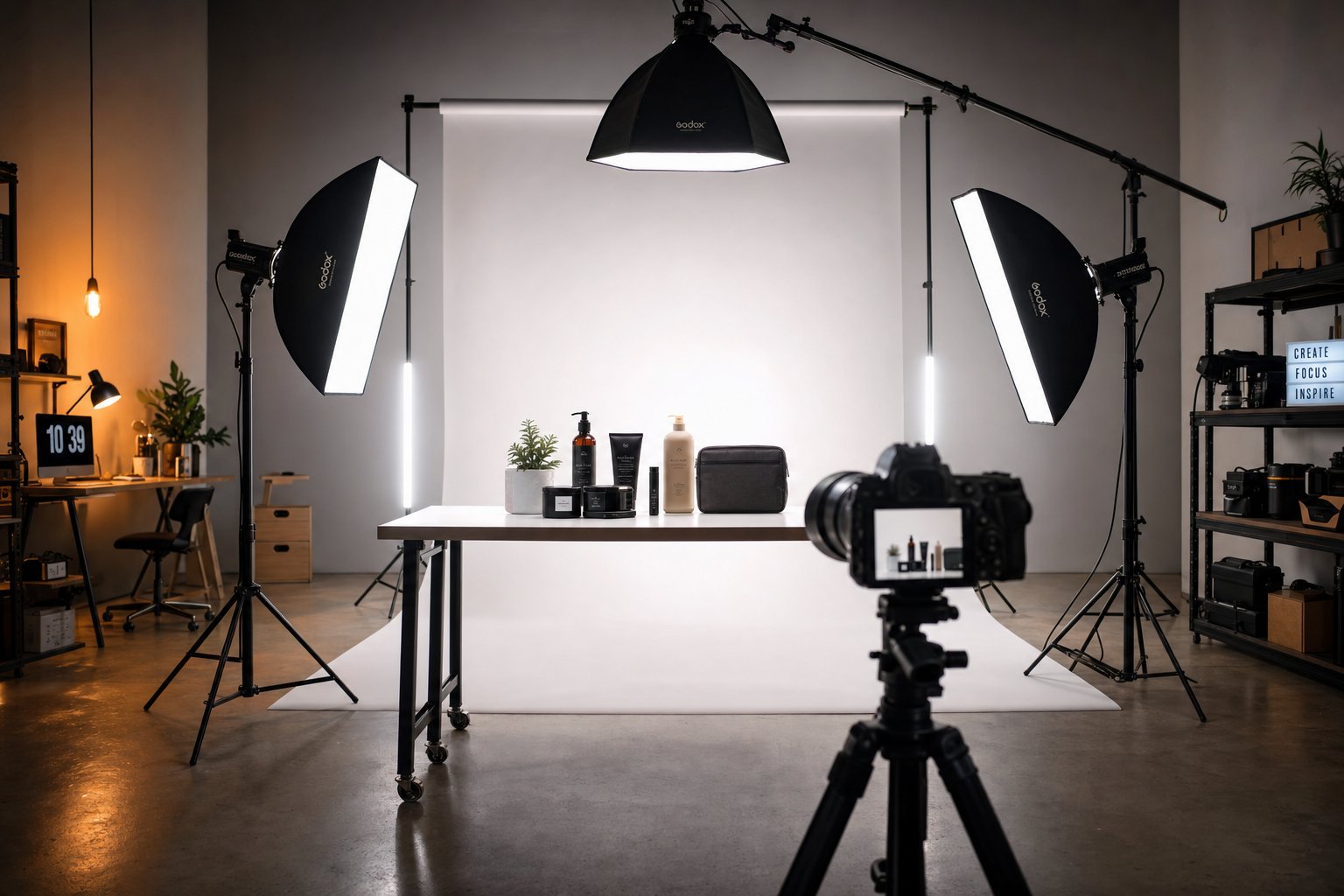
Consistency within a single project. Ask to see a full client catalog, not a best-of reel. Cohesive lighting, color, and shadow treatment across dozens of images from one brand is the clearest proof of repeatable results. Anyone can produce one great frame; consistency across a set is the skill you are paying for.
Relevance to your category. Reflective jewelry, transparent packaging, and textured fabric each demand different technical skills. If the portfolio shows nothing close to your products, the polished samples tell you little about how the studio will handle yours. Ask for category-specific examples, and if none exist, treat a paid test as mandatory.
Real clients versus stock. Confirm the work was produced for paying clients, not assembled from licensed stock or stylized personal projects. Real client work carries the constraints — varied product quality, brand guidelines, deadlines — that mirror your own engagement. A portfolio that feels too perfect sometimes is, because it never had to survive a real brief.
Pricing Models and Hidden Costs
Studios price their work in a few common ways, and understanding the structure is what lets you compare quotes fairly instead of being swayed by a low headline number. The model also tells you which kind of project a studio is built for.
Per-image pricing is usually the most transparent: a set rate per final retouched image, predictable when you know how many shots you need. Per-hour or day-rate billing bundles shooting time into blocks and offers better value when you run many products through one session. Subscription or retainer models lock in a recurring volume at a reduced rate and suit brands shooting on a steady cadence. None is inherently better — the right one depends on how predictable and how large your volume is.
The real budgeting risk lives in the extras, frequently quoted separately or not mentioned until the work is done. Watch for these in particular:
- Styling and prop sourcing — arranging compositions or sourcing backgrounds and props can be billed on top of the shoot fee.
- Retouching depth — basic color correction is often included, but composites, background replacement, or advanced cleanup typically cost extra per image.
- Rush turnaround — compressed timelines usually carry a meaningful surcharge over standard rates.
- Model or talent fees — on-model shots add talent costs that can dwarf the photography itself.
The fix is simple to ask for and revealing in the response: request a written quote that breaks every one of these into a separate line item. A studio that provides it is structured around transparency; one that insists on a single bundled figure is leaving room to add charges later — which you usually discover after the work, and your leverage, are gone.
Contract Terms and Image Rights You Must Confirm
Paying for a shoot does not automatically make you the owner of every right attached to the resulting images. This is the clause that catches the most brands off guard, often months later when a usage limit blocks a campaign. Read the contract for these four points before you sign.
Usage and licensing. Confirm in writing exactly where you may use the images — your store, marketplaces, paid social, email, print, and packaging. A license that covers your website but not advertising can quietly stop a paid campaign before it starts.
Exclusivity. Clarify whether the imagery is exclusively yours or whether the studio may reuse it — in its own portfolio, in stock libraries, or with another client. For distinctive products, non-exclusive terms can mean your visuals show up somewhere you would rather they did not.
Raw files. Decide up front whether you receive the unedited source files. Many studios deliver only finished exports by default and charge separately for raws. If you may want to re-edit later, negotiate this before the shoot, not after.
Kill and cancellation fees. Understand what you owe if you cancel, postpone, or scrap the project after booking. A reasonable cancellation policy is normal; an open-ended kill fee is a reason to negotiate or walk away. Knowing the number before you commit keeps a schedule change from becoming an unexpected bill.
When to Skip the Studio
Not every brand needs a studio relationship, and forcing one can cost more than it returns. There are clear situations where the economics and the logistics simply do not favor a traditional contract.
Small or fast-changing catalogs. If you carry a handful of products and swap them often, the overhead of briefing, shipping, and scheduling a studio for each change outweighs the benefit. The setup cost of a shoot is hard to justify when the products themselves rotate before the images have earned their keep.
Tight budgets. When per-image fees would multiply painfully across your catalog, a contract studio can become the most expensive line in your operation. A brand watching every dollar is usually better served by an approach where the cost per image is transparent and low rather than negotiated shoot by shoot.
Frequent restocks. If you constantly add SKUs or refresh variations, the multi-week turnaround of a traditional studio becomes a bottleneck. Photography that cannot keep pace with your product velocity ends up gating your launches instead of supporting them.
In each of these cases the issue is not that studios are bad — it is that a contract studio is the wrong tool for a high-velocity, cost-sensitive, or small-catalog workflow. That is exactly the gap a different kind of studio is built to fill.
The AI Studio Alternative
When a contract studio is the wrong fit, an AI product photography studio addresses the same problems from the opposite direction. Instead of negotiating scope, scheduling a shoot, and shipping inventory, you upload a basic product photo and generate marketplace-ready visuals directly. The structural advantages line up neatly against the red flags this guide has covered.
- No contract. There is nothing to sign, no kill fee, and no usage clause to scrutinize — you are not locked into a commitment that has to be unwound if your needs change.
- Transparent per-image cost. Pricing is visible and predictable up front, with none of the hidden styling, rush, or retouching add-ons that surface after a traditional shoot.
- Fast turnaround. Output arrives in minutes rather than the weeks a studio needs, which removes the launch-window risk entirely.
- Consistent output. The same visual treatment applies uniformly across your whole catalog, solving the inconsistency that haunts patchwork studio work.
The workflow is straightforward. Start with a clean source image — even a flat lay or a phone photo on a plain background works. If the background is busy, run it through a free background remover first, then generate scenes, white-background listing shots, or lifestyle variations from there. For routine, high-volume, fast-moving catalog work, this is often the better economic and operational fit.
None of this means physical studios have no place — flagship hero imagery, complex reflective surfaces, and material-critical categories still benefit from a controlled shoot. The point is to match the method to the job rather than defaulting to a contract you may not need. For everything else, an AI studio removes the contract, the wait, and the surprise invoice at once.
Try the Snappyit AI product photography studio free →
Frequently Asked Questions About Hiring a Studio
How do I know if a product photography studio is reliable before I hire them?
Reliability shows up in the details, not the highlight reel. Ask for a full client catalog rather than cherry-picked hero shots, request a small paid test shoot, and confirm fixed per-image pricing, a written turnaround date, and a clear revision and reshoot policy in advance. A studio that answers all of these in writing without hedging is far more likely to deliver consistently than one that leans on an impressive portfolio and vague promises.
What is the single biggest red flag when vetting a studio?
Refusing a paid test shoot is the loudest warning sign. A confident studio is happy to prove its real day-to-day output on a few of your actual products for a small fee, because it knows the result will match its portfolio. Reluctance usually means the showcased work relies on one talented contributor, heavy retouching, or favorable products that may not reflect what you will receive at volume.
Do I automatically own the images once I pay the studio?
Not necessarily. Paying for a shoot often buys you a license to use the images in specific ways, not full ownership of the copyright. Always confirm in writing where you may use the photos — your store, marketplaces, paid ads, email, print, and packaging — and whether you receive the raw files. A missing or narrow usage clause can block you from running your own product photos in an ad campaign months later.
How should a studio structure its pricing so I avoid surprise costs?
Look for a written quote that separates the shoot fee, retouching, styling, props, rush charges, model fees, and any licensing cost into clear line items. Per-image pricing is usually the most transparent for predictable catalog work, while day rates suit large batches shot in one session. The warning sign is a single bundled number with no breakdown, because the extras that are not included tend to surface as add-ons after the work is done.
When does it make more sense to skip a studio entirely?
Skip the contract studio when your catalog is small, fast-changing, or restocked frequently, when launch timelines are too tight for multi-week turnaround, or when per-image fees would multiply painfully across hundreds of SKUs. In those situations an AI product photography studio is often the better fit, since it offers transparent per-image cost, fast turnaround, consistent output, and no commitment to lock into a contract.
Vet Smarter, or Skip the Studio Entirely
Hiring a product photography studio comes down to refusing to take the portfolio at face value: insist on a full catalog, a paid test, dated turnaround, line-item pricing, and explicit image rights before any money changes hands. And when the math or the timeline does not favor a contract at all, an AI studio gives you the same marketplace-ready visuals without the commitment.
Generate your first product photo free →