
At a glance
3D ghost mannequin makes apparel look 3D-worn from multiple angles. See how AI tools create the effect — workflow, cost, comparison vs studio.
| Need | What to do |
|---|---|
| Get oriented | Read the short summary, then use the checklist below. |
| Create a test image | Try Ghost Mannequin Free |
Search data for apparel photography terms is showing a pattern: 3D ghost mannequin is emerging as a distinct query in its own right, separate from the broader ghost mannequin or invisible mannequin terms. The qualifier "3D" signals a specific output style — not a single front-facing 3D-worn shot, but a complete multi-angle set where the same garment is rendered from front, back, and quarter-angle viewpoints with consistent dimension and matching interior detail.
Two years ago, producing a 3D ghost mannequin set required a studio shoot from multiple angles plus 30 to 60 minutes of Photoshop neck-joint editing per shot — easily $100 to $300 per garment. AI tools have collapsed that workflow into a single upload that returns a complete 4-angle 3D ghost mannequin set in under 90 seconds, at under $1 per garment. The cost gap is roughly 100×.
This guide explains what 3D ghost mannequin specifically means, how it differs from standard 2D ghost mannequin output, what each production method costs in 2026, and the AI workflow for generating multi-angle ghost mannequin shots from one flat-lay photo. By the end you'll know whether 3D ghost mannequin makes sense for your catalog and which method fits your scale.
What Is 3D Ghost Mannequin?
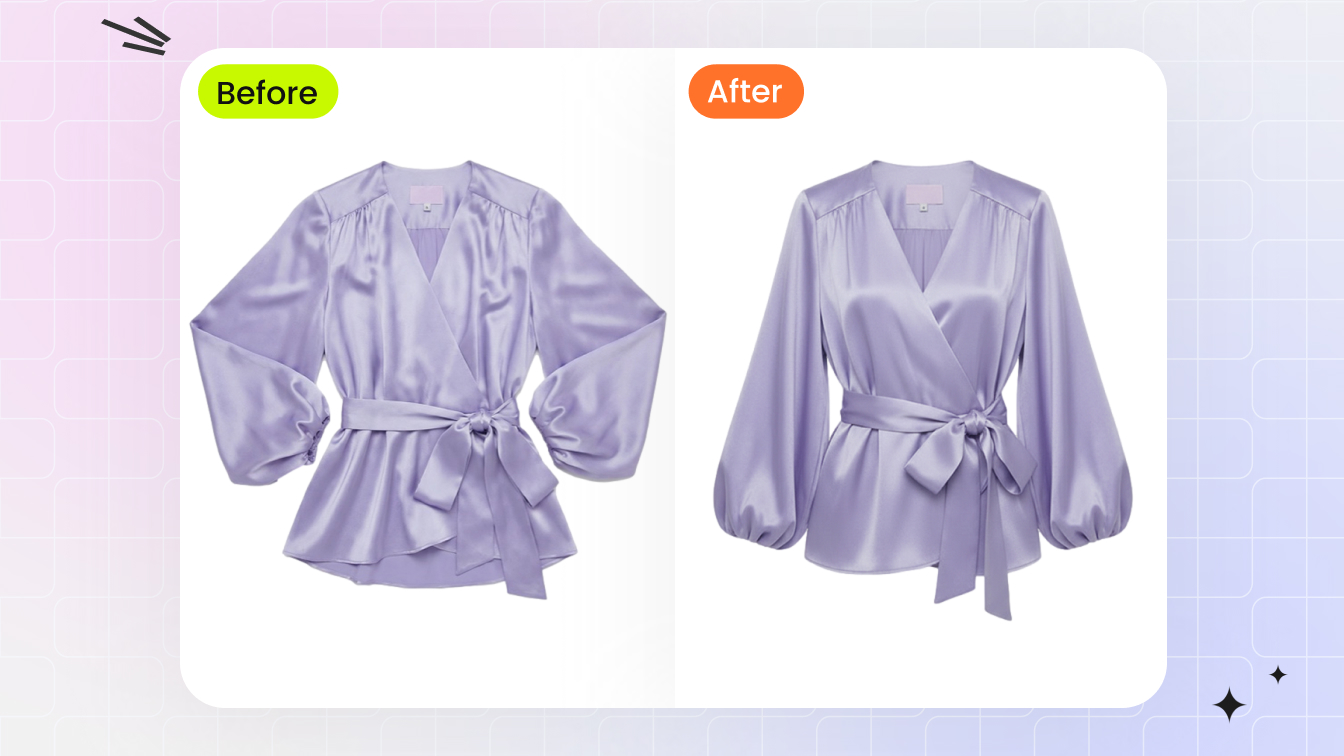
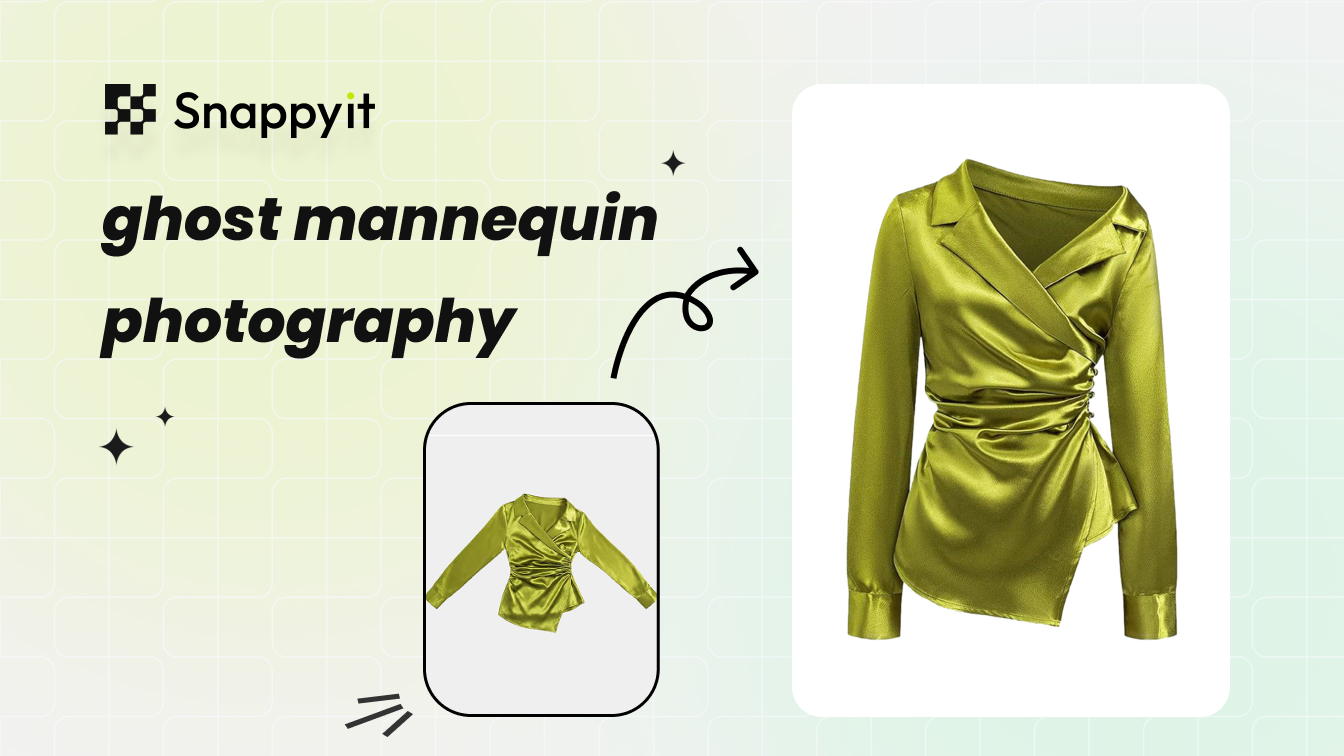
The 3D ghost mannequin effect is product photography output where a garment appears 3D-worn — preserving its full shape, drape, and interior detail — from multiple angles, with no model in any frame. The standard 3D ghost mannequin set consists of four images: front, back, and two quarter-angle views (typically front-quarter and back-quarter). Some tools and outsourced services produce a 360° rotation set with 8 to 24 frames, but four angles is the e-commerce standard for product detail page carousels on Amazon, Shopify, and Etsy.
Three characteristics distinguish true 3D ghost mannequin output from 2D ghost mannequin: (1) multi-angle coverage, where the same garment is rendered consistently across at least three distinct viewpoints; (2) interior visibility from each angle, meaning the inside of the back neckline shows through the front opening on the front shot, and the inside of the front neckline shows through the back opening on the back shot; (3) consistent dimensional rendering, where shoulder width, hem length, and proportions stay accurate across all four angles so the buyer perceives the same garment, not four different generated outputs. Tools that fail any of these three tests are doing 2D ghost mannequin with extra steps, not true 3D ghost mannequin.
3D vs 2D Ghost Mannequin: What's the Difference?
The terminology overlap is genuine — both 2D and 3D ghost mannequin produce the invisible-mannequin look. The difference is how many angles you ship to your listing. 2D ghost mannequin is one front-facing image; 3D ghost mannequin is the same garment shown from front, back, and quarter views as a coordinated set. Here is the practical comparison:
| Dimension | 2D Ghost Mannequin | 3D Ghost Mannequin |
|---|---|---|
| Output count | 1 image (front) | 4 images (front, back, 2 quarters) |
| Cost (AI, 2026) | $0.07–$0.20 per image | $0.20–$0.80 per set |
| Cost (studio + Photoshop) | $25–$75 per image | $100–$300 per set |
| Output time (AI) | ~30 seconds | 60–90 seconds |
| Listing slot | Main image (slot 1) | Carousel slots 2–5 |
| Best for | Amazon main listing image | Product detail page carousels |
For Amazon apparel sellers, the main listing image is required to be a single product-only shot — that is where 2D ghost mannequin lives. Amazon's secondary images can be model shots, lifestyle, or additional angles, and 3D ghost mannequin is what fills the rest of the carousel. The same applies to Etsy, Shopify, and most fashion DTC sites where the product detail page now includes 4 to 8 carousel slots. 2D ghost mannequin fills slot 1; 3D ghost mannequin fills slots 2 through 5.
The cost of producing a 3D ghost mannequin set used to be roughly 4× the cost of a 2D shot — you needed four full studio setups instead of one. With AI tools that generate all four angles from a single flat-lay input, the cost differential has compressed to roughly 2 to 3× because the AI still needs to predict more invisible geometry on the back and quarter views than on the front alone.
Pure 2D ghost mannequin remains the right choice for catalog listings where the buyer's main question is "what does the garment shape look like?" — flat-lay catalogs, wholesale sheets, listing thumbnails. 3D ghost mannequin earns its premium when the buyer's question becomes "how does it look from behind, from the side, and worn?" That second question is what drives most online apparel returns.
Why Brands Use 3D Ghost Mannequin in 2026
Three reasons explain why marketplace listings increasingly include 3D ghost mannequin shots as standard, not as optional add-ons:
- Conversion lift. Research from BigCommerce and Shopify consistently shows that multi-angle product photography increases add-to-cart rate by 8 to 12% over single-image listings. Buyers who can see how a garment falls from behind or from the side make faster purchase decisions and report fewer post-purchase concerns. The 3D ghost mannequin format delivers exactly that multi-angle coverage in a coordinated set.
- Lower return rate. Apparel returns are driven heavily by fit ambiguity — the buyer guessed wrong about how the garment would actually look on a body. Showing the garment from front, back, and quarter views removes most of that uncertainty, which directly lowers the return rate. Brands that have moved from 2D-only to 3D ghost mannequin output report 10 to 15% return-rate reductions in apparel categories.
- Marketplace algorithm preferences. Amazon's apparel category explicitly recommends 5 or more images per listing, with multiple angles preferred. Shopify's product page templates default to a 4 to 8 slot carousel that 3D ghost mannequin sets fill perfectly. Etsy and eBay both reward listings with multi-angle photography in their internal ranking models — so a 3D ghost mannequin set is both a conversion lever and a search-visibility lever.
- AR try-on and 360° viewers. The next layer of product visualization (AR try-on apps, Shopify's 3D Viewer, marketplace-embedded turnaround features) all consume multi-angle ghost mannequin sets as input. Investing in 3D ghost mannequin output now sets your catalog up for these features without the need to re-shoot existing inventory.
These four drivers compound. Every marketplace platform, every conversion-optimization study, and every emerging product-visualization technology rewards multi-angle ghost mannequin output. The question for sellers in 2026 is no longer whether to use 3D ghost mannequin output, but which production method fits the catalog scale and budget.
How to Create 3D Ghost Mannequin (3 Methods)
There are three production paths to a 3D ghost mannequin set in 2026. They differ on cost per set, time per set, and minimum order size.
Method 1 — Studio multi-angle shoot + Photoshop
Set up a real white or skin-toned mannequin and shoot it from four angles (front, back, front-quarter, back-quarter) under matched lighting. For each angle, take a separate interior-neckline shot. In Photoshop, mask the mannequin out of each shot and composite the interior shot using the neck-joint technique. This produces the highest-fidelity 3D ghost mannequin output but is the most expensive option — plan on $80 to $200 per garment when accounting for studio time, mannequin setup, lighting, and 20 to 60 minutes of Photoshop work per angle. Best for editorial brands and high-end fabrics where pixel-perfect control matters.
Method 2 — Outsourced multi-angle editing
Send your raw multi-angle photos (still requires a studio shoot of the garment from multiple angles) to a service like Pixelz or Path Edits. The service handles all four neck-joint composites, color matching across angles, and consistency tweaks. Cost ranges from roughly $4 to $12 per complete 3D ghost mannequin set on Path Edits' simple-tier pricing, or $6 to $15 on Pixelz. Turnaround is 6 to 24 hours. This is the safest middle-ground option for sellers who want manual quality control without setting up an in-house Photoshop pipeline.
Method 3 — AI single-flat-lay → multi-angle output
Upload one flat-lay photo to an AI tool like Snappyit's AI Ghost Mannequin generator. The AI predicts not just the front 3D shape but the full underlying geometry, then renders the garment from four angles in a single batch. No mannequin, no multi-angle shoot, no Photoshop work. Output time is 60 to 90 seconds for the complete 3D ghost mannequin set; cost is around $0.20 to $0.80 per set on Snappyit's annual plan. The tradeoff is that AI inference quality on the back and quarter views is harder than the front (less training data, more invisible geometry to hallucinate), so results need spot-checking on tricky garments — sheer fabrics, complex prints, asymmetric cuts.
Try the AI route on your own garment. Free credits, no card required. Try Snappyit Ghost Mannequin free →
The AI Workflow Step-by-Step
Method 3 — single-flat-lay AI generation — has become the dominant 3D ghost mannequin workflow for sellers under 1,000 SKUs per month because of the cost and speed advantage. Here is the actual flow:
- Upload a flat-lay (~10 seconds). Lay the garment flat on a neutral surface and photograph it top-down with even lighting. Phone-quality is acceptable; a steamed garment with clean edges is more important than camera resolution. The AI works from this single input — no second interior shot, no multi-angle source set required.
- Select 3D output mode (~5 seconds). On Snappyit's Ghost Mannequin tool, the 3D mode is a one-click option that requests a 4-angle set instead of a single front shot. Other AI tools either default to 3D mode or expose it as a setting in the workflow panel.
- AI generates the multi-angle set (~60–90 seconds). The model first predicts the underlying 3D garment geometry from the flat-lay, then renders the garment from front, back, front-quarter, and back-quarter viewpoints with consistent dimension and matching interior detail across all four images.
- Review and download (~instant). Open each angle and check that proportions, color, and interior neckline detail look right. If one angle looks wrong, regenerate it specifically — no need to re-process the whole set. Download as PNG files or upload directly to your Shopify or Amazon listing.
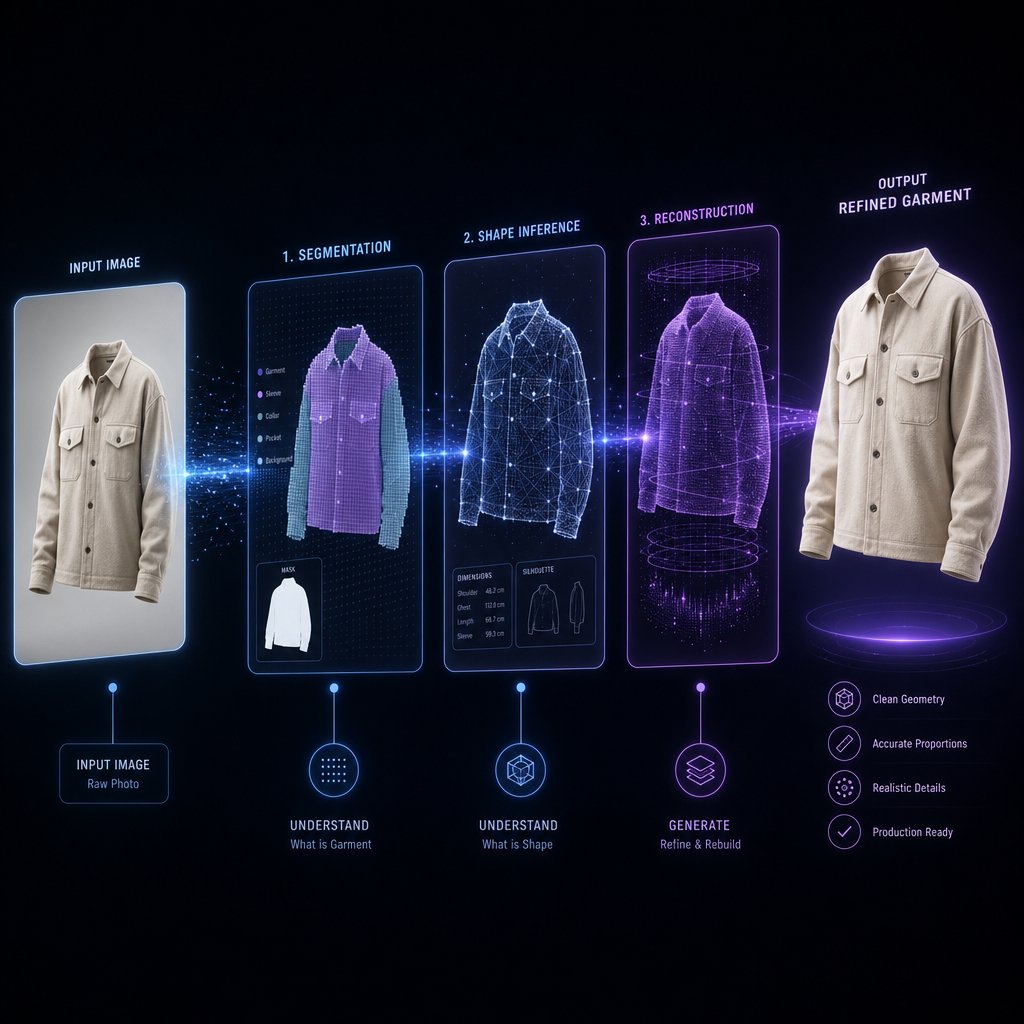
The full end-to-end time from flat-lay capture to listing-ready 3D ghost mannequin set is typically 5 minutes — 30 seconds for the photo, 90 seconds for AI processing, 90 seconds for visual review and quality check, and 60 seconds to upload to your store. Compared with the studio + Photoshop workflow that runs to multiple hours per garment, the AI workflow is the largest single productivity compression in apparel photography in two decades.
Cost & Time Comparison: 3D vs 2D vs Studio
The apples-to-apples comparison for one complete 3D ghost mannequin set (4 angles), assuming you already have your garment in hand:
| Method | Cost per 3D set | Time per 3D set | Notes |
|---|---|---|---|
| AI single-flat-lay (Snappyit) | $0.20–$0.80 | ~5 minutes end-to-end | One flat-lay input, four-angle output. Free trial credits. |
| Outsourced (Path Edits) | $4–$12 | 6–24 hour turnaround | Requires studio shoot of multi-angle source photos first. |
| Outsourced (Pixelz) | $6–$15 | 3–24 hour turnaround | AI cutout + human review. API for batch. |
| In-studio + Photoshop | $80–$200 | 2–4 hours (excl. studio setup) | Full studio + 4-angle shoot + manual neck-joint × 4. |
The cost gap between AI tools and the traditional studio + Photoshop workflow is roughly 100× per 3D ghost mannequin set. The gap with outsourced services like Path Edits and Pixelz is closer to 5 to 10×, which is what makes those services still viable for sellers who need human-reviewed consistency at scale. For Etsy resellers and Shopify boutiques under 500 SKUs per month, the AI route is almost always the right choice — at $0.20 to $0.80 per set, you can re-generate dozens of times if you need to. For enterprise apparel catalogs above 5,000 SKUs per month, the calculus shifts: human-reviewed output from Pixelz becomes worthwhile when a single bad image on a high-volume listing costs more in lost conversion than the per-set premium.
Generate your first 3D ghost mannequin set free. One flat-lay in, four angles back in 90 seconds. Try Snappyit free →
Best Use Cases for 3D Ghost Mannequin
The 3D ghost mannequin format earns its premium in four specific catalog scenarios:
Amazon apparel listings with carousel images
Amazon's apparel listings allow up to 9 images. The main image must be product-only (typically 2D ghost mannequin or equivalent), but slots 2 through 5 are typically used for additional angles, lifestyle, and detail shots. A 3D ghost mannequin set fills slots 2 through 4 with consistent multi-angle product photography that buyers can rotate through without leaving the listing — directly improving the conversion metrics Amazon's algorithm rewards.
Shopify boutique product detail pages
Shopify's default product page template includes a thumbnail carousel that holds 4 to 8 images. A 3D ghost mannequin set populates the carousel with coordinated multi-angle shots that stay on-brand. For boutiques selling seasonal collections, generating fresh 3D ghost mannequin sets each season is now economically viable with AI tools at $0.20 to $0.80 per set — well within a per-SKU photography budget.
Etsy resellers cycling unique inventory
Resellers handling vintage, secondhand, or one-off inventory cannot justify per-item studio setups. AI 3D ghost mannequin generation means each unique garment gets a full multi-angle treatment in 5 minutes — economically viable for the first time. Etsy's SEO ranking model also rewards listings with multiple high-quality images, which means 3D ghost mannequin output is both a conversion lever and a discovery lever for resellers.
AR try-on and 360° product viewers
Multi-angle ghost mannequin output is the input format for AR try-on apps and Shopify's 3D Viewer. Investing in 3D ghost mannequin output now means your catalog is already prepared for AR features when they roll out, or when you choose to enable them on existing storefront platforms. This forward-compatibility argument alone justifies the small per-set premium over 2D-only output.
Common Pitfalls and How to Spot Them
Five recurring problems show up in low-quality 3D ghost mannequin output. Knowing what to spot before publishing saves a re-shoot or re-generation later:
- Inconsistent shoulder width across angles. The front shot shows the garment with one shoulder width, the back or quarter view shows a different width. AI tools sometimes drift on geometry across angles. Visual check: line up the four shots in a horizontal strip and verify the shoulder span looks identical.
- Wrong interior neckline on the back shot. The back shot's interior should show the inside of the front neckline (visible through the back opening). Many AI outputs incorrectly mirror the front interior or produce a closed back neckline, which gives the garment an unnatural seam-sealed appearance.
- Lighting inconsistency between angles. The front shot looks bright, the back shot looks darker. AI inference for the back and quarter angles uses different visual cues than the front, occasionally producing exposure shifts. Spot-check by comparing hem color and fabric tone across all four angles in the set.
- Quarter views that don't match the implied rotation. The front-quarter shot should look like the front shot rotated 30 to 45 degrees. If the garment looks shifted, compressed, or stretched in the quarter view, the AI is generating an inconsistent rotation rather than truly rotating the front geometry around a vertical axis.
- Color drift on patterned fabrics. Stripes, plaids, and complex prints can shift slightly across the four angles. AI tools struggle to maintain pixel-perfect pattern alignment on the back and quarter angles. For pattern-critical garments, fall back to manual workflow or outsourced services that can tweak each angle individually.
Frequently Asked Questions
What is 3D ghost mannequin in product photography?
3D ghost mannequin is product photography where a garment appears 3D-worn — preserving shape, drape, and interior detail — from multiple angles (typically front, back, and two quarter views), with no model or mannequin in any frame. The format produces a complete 4-image set suitable for product detail page carousels on Amazon, Shopify, Etsy, and most apparel marketplaces.
What is the difference between 3D and 2D ghost mannequin?
2D ghost mannequin is a single front-facing image of the garment in its 3D-worn shape, used as the main listing image. 3D ghost mannequin is a multi-angle set (front, back, front-quarter, back-quarter) used to fill product detail page carousels. Same underlying technique, different number of angles. AI tools now produce both formats from a single flat-lay input, though 3D output requires more inference work and costs roughly 2 to 3× as much as 2D.
Can AI tools create 3D ghost mannequin from a single flat-lay photo?
Yes. AI tools like Snappyit generate a complete 4-angle 3D ghost mannequin set from one flat-lay photo in 60 to 90 seconds. The model first predicts the underlying 3D garment geometry from the flat-lay, then renders the garment from each requested viewpoint with consistent dimension and matching interior detail. No multi-angle photo shoot, no mannequin, no Photoshop work required for the standard case.
How much does a 3D ghost mannequin set cost per garment in 2026?
AI tools cost roughly $0.20 to $0.80 per complete 4-angle set on annual plans (Snappyit Basic at $6.9/mo gives 100 credits, with each 3D set typically using 2 to 4 credits). Outsourced editing services like Path Edits charge $4 to $12 per set. Studio shoots with manual Photoshop run $80 to $200 per garment depending on complexity. The cost gap between AI and traditional methods is roughly 100×.
Which AI tool is best for 3D ghost mannequin?
For sellers under 1,000 SKUs per month, Snappyit offers the best cost-to-quality ratio on 3D ghost mannequin output, with a true 3D output mode and free trial credits on signup. SellerPic also produces multi-angle ghost mannequin output with strong virtual try-on integration. For enterprise volumes, Pixelz's hybrid AI-plus-human workflow earns its per-set premium through human review on every angle in the set.
Does Amazon require 3D ghost mannequin for apparel listings?
No. Amazon requires only one main product image (2D ghost mannequin or equivalent product-only shot) for apparel listings. However, Amazon's apparel listings allow up to 9 images and explicitly recommend multiple angles. 3D ghost mannequin sets fill carousel slots 2 through 5 with coordinated multi-angle photography, which Amazon's internal ranking model rewards in apparel-category search results.
How long does AI 3D ghost mannequin generation take?
A complete 4-angle 3D ghost mannequin set takes 60 to 90 seconds end-to-end on AI tools like Snappyit. Front and back angles process faster (around 20 seconds each); quarter views typically take longer because the AI needs to interpolate more invisible geometry. Total workflow time including upload, visual review, and download is around 5 minutes per garment.
Can I get 360° rotation from 3D ghost mannequin output?
Some AI tools and outsourced services produce 8 to 24 frame 360° rotation sets from a single flat-lay input, useful for AR try-on apps and embedded 360° product viewers on Shopify and BigCommerce. The cost scales linearly with frame count: an 8-frame rotation set is roughly 2× the cost of a 4-angle 3D ghost mannequin set; a 24-frame rotation runs 5 to 6×. For most catalog listings, the standard 4-angle 3D ghost mannequin set is sufficient.
The Bottom Line
The 3D ghost mannequin format has moved from a high-end production option to a practical default in 2026. AI tools generate complete 4-angle ghost mannequin sets from a single flat-lay in 60 to 90 seconds at under $1 per garment, collapsing what used to be a $100 to $300 multi-day workflow into something a single seller can run from a phone. For Amazon apparel listings, Shopify boutiques, Etsy resellers, and DTC fashion brands, the question is no longer whether to ship 3D ghost mannequin output — it's which production method fits the catalog scale.
The traditional studio + Photoshop workflow still has a role for editorial brands and difficult-to-render fabrics where pixel-perfect manual control matters. Outsourced services like Pixelz earn their premium when human-review consistency on every angle is worth the per-set cost. But for the 80% case — independent sellers, boutiques, and small DTC brands cycling new inventory — AI 3D ghost mannequin generation is now the obvious default workflow.
Try 3D Ghost Mannequin on Your Own Garment
Upload one flat-lay photo. Get a complete 4-angle 3D ghost mannequin set back in 90 seconds. Free credits on signup, no payment information required to start.