
At a glance
Complete guide to selling swimwear online in 2026: platform comparison, listing optimization, photography, pricing, marketing — Etsy, Amazon, Shopify, TikTok.
| Need | What to do |
|---|---|
| Get oriented | Read the short summary, then use the checklist below. |
| Create a test image | Try AI Fashion Model Free |
TL;DR — how to sell swimwear online in 2026
To sell swimwear online in 2026, pick one or two platforms and execute the full stack on each instead of spreading thin across five. Etsy is the default for indie / handmade swimwear under $80; Amazon is the default for branded swimwear over $40 with consistent inventory; Shopify is the default for DTC brands with a marketing budget; TikTok Shop is the breakthrough channel for sub-$30 trend-driven swimwear. The fastest path to sell swimwear online profitably in 2026 starts on Etsy for product validation, then layers Shopify for brand-building once you have 50+ units of repeat demand.
The economics to sell swimwear online break into three buckets. Print-on-demand: $0–$500 to validate, 15–25% margins after fees. Small-batch inventory: $2,000–$5,000 startup, 35–50% margins. Premium full-collection: $15,000+ startup, 50–65% margins. Whichever path you pick to sell swimwear online, the photo budget compresses dramatically with AI fashion model tools — sub-$0.10 per output replaces the $2,000–$10,000 per day a real swimwear shoot used to cost.
The complete playbook below covers platform selection, listing optimization, photography requirements per platform, pricing math, marketing channels, and the 2026 Amazon compliance rules every seller needs before launch. Read in order or skip to the section that matches your current stage.
The Swimwear Market in 2026: What Sellers Need to Know
Global swimwear ecommerce is on track to clear $27.67 billion in 2026 (per Statista and Mordor Intelligence; $25.77 billion in 2025), with the fastest growth in the resort and "swim-to-everywhere" categories — pieces designed to work as both swimwear and casual wear. The market is increasingly fragmented: smaller indie brands now capture share that used to belong to large incumbents, and direct-to-consumer Shopify stores are growing faster than marketplace listings.
For a new or growing swimwear seller in 2026, three structural shifts matter:
- Seasonal compression — the buying window has shrunk. Mid-March through early July captures 48% of annual revenue. Inventory and listings need to be live by February for the peak.
- Size inclusivity expectation — buyers across all platforms now expect ranges from XS through 4X or larger. Brands that ship only standard sizing see depressed conversion.
- Photography arms race — AI-generated model imagery has made high-quality on-body photos table stakes. Sellers without on-body imagery now visibly underperform sellers with it.
This guide walks through choosing a platform, building listings, handling photography, and pricing — for the actual conditions of selling swimwear in 2026, not the playbook from three years ago.
Choosing Your Sales Platform
The first decision is where to sell. The honest answer in 2026 is "more than one place" — but you should start somewhere specific.
Etsy: Best for Small Indie Brands
- Strengths — handmade and small-batch aesthetic, lifestyle-friendly photography, strong returning-customer dynamics.
- Weaknesses — listing fees stack ($0.20 per listing × 50 listings × 4 month listing duration), search algorithm rewards consistency, intense competition in popular keywords.
- Best fit — under 100 SKUs, unique designs, premium-priced or vintage-styled swimwear.
Amazon: Best for Volume
- Strengths — massive search traffic, fast scaling, Prime shipping advantage.
- Weaknesses — strict image specs, intense price competition, brand-anonymous (buyers shop the category, not the seller), elevated return rates.
- Best fit — 100+ SKUs, competitive pricing, consistent inventory, willingness to ship in Amazon spec.
Shopify: Best for Brand Building
- Strengths — full control over store design, customer relationship, no platform commission beyond payment processing, owned email list.
- Weaknesses — no built-in traffic, requires marketing investment (ads, SEO, influencer), longer time-to-revenue.
- Best fit — brands with a distinct identity, existing audience or willingness to build one, planning long-term.
TikTok Shop: Best for Trend-Driven Pieces
- Strengths — viral discovery dynamics, video-native, low CAC for the right product.
- Weaknesses — algorithm-dependent revenue (no algorithm love = no sales), young buyer demographics, requires content production capacity.
- Best fit — visually distinctive product, willingness to produce 5-20 short videos per week, lower-price-point items.
Cross-Listing
Most successful 2026 swimwear sellers run on at least two platforms — typically Etsy + Shopify, or Amazon + Shopify, or all three plus TikTok Shop. Cross-listing tools handle the inventory sync; see our cross-listing tool comparison.
Etsy Swimwear Listings That Convert
Etsy's algorithm rewards keyword-matched titles, complete listing fields, and visual consistency. The 2026 best-practice structure:
- Title — 110-140 characters using primary keyword first, then descriptors. Example: "High-Waisted Bikini Set, Tropical Print Two-Piece Swimsuit, Tie-Side Bottom, Halter Top, Beach Vacation Outfit."
- Tags — fill all 13 tags. Mix exact-match keywords with long-tail variants. Avoid duplicate keywords in tags and title.
- Categories and attributes — fill every dropdown. The platform rewards listings with complete attribute data.
- Description — 150-250 words. Lead with the use case (beach, pool, vacation), then specs (fabric, sizing, care), then differentiation.
- Photos — 8-10 images per listing. Cover: flat-lay or styled lifestyle. Detail shots: fabric, stitching, hardware. On-body: at least two angles. Variant photos for colors.
- Pricing — anchor in the middle of your category. Underpricing signals low quality; overpricing without strong photos kills conversion.
Full Etsy walkthrough including SEO and shipping setup: our complete Etsy guide.
Amazon Swimwear Listings
Amazon is more rigid. The platform image review will reject listings that fail spec, and ranking comes from a different signal mix than Etsy.
Amazon Image Spec for Swimwear
- Main image: pure white background (#FFFFFF), 1:1 aspect, 2000-3000px recommended on longest side (1000px minimum), garment fills 85% of frame, no text/graphics/borders.
- Secondary images (up to 8 more): on-body, in-context, detail, fabric close-up, scale reference, and lifestyle. Use all 9 slots.
- Video: 9:16 or 1:1 product video, 6-30 seconds, optional but boosts conversion 20-40% when present.
Amazon Listing Optimization
- Title — 150-200 characters. Brand → primary keyword → key features → size/color in title.
- Bullet points — 5 bullets, each 200-250 characters. Lead each with a benefit, follow with proof.
- Backend keywords — fill the 250-character backend search field with related terms not in the title.
- A+ content — if brand-registered, use enhanced brand content to add lifestyle imagery and brand storytelling below the standard description.
Shopify Standalone Stores
A standalone Shopify swimwear store gives you full control but no traffic by default. The 2026 launch playbook:
- Pick a focused niche — "modest swimwear for moms," "athletic swimwear for surfers," "size-inclusive resort wear." Generic "swimwear store" cannot compete against established brands.
- Build a tight initial collection — 12-30 SKUs is enough for launch. Bigger catalog = more diluted brand signal.
- Photograph everything consistently — single visual treatment across all SKUs. AI tools make this much easier in 2026; see the photography section below.
- Launch with a small ad budget — $20-50/day on Meta or TikTok to drive initial traffic and gather data.
- Capture email from day one — pop-up offer, footer signup, post-purchase opt-in. Email becomes your most-profitable channel within 6 months if you build it.
- Add content to drive organic — buyer's guides, size charts, fabric explanations. Long-form content brings SEO traffic that paid traffic cannot replace.
Print-on-Demand vs Inventory
Two operational models compete in 2026 swimwear: traditional inventory (you buy or manufacture, you hold stock, you ship) and print-on-demand (you upload designs, the POD partner manufactures and ships per order).
Inventory Model
- Pros — better margins (30-60% vs 20-35% POD), faster shipping, full quality control, lower per-unit costs at volume.
- Cons — capital tied up in stock, sizing risk (wrong sizes don't sell), warehouse costs.
Print-on-Demand Model
- Pros — zero inventory risk, unlimited design experimentation, faster product-market-fit testing.
- Cons — slimmer margins, longer fulfillment times, less control over quality, design constraints.
The 2026 Hybrid Recommendation
Start with print-on-demand to validate designs and find your best-sellers. Once you have 5-10 SKUs that consistently sell more than 50 units per month, transition those to inventory while keeping new designs on POD. This minimizes risk while improving margin on proven winners.
Photography Requirements by Platform
Every platform has different photo specs. Building one source library that exports to every spec saves multiple shoots.
- Etsy — 4:5 aspect at 2000×2500 px recommended, lifestyle-friendly. Square or landscape both work. 8-10 photos per listing.
- Amazon — main image strict (1:1 white background), secondary images flexible. 9 photos plus video preferred.
- Shopify — full control. 4:5 vertical works best for mobile-first display. 6-12 photos per product page.
- TikTok Shop — vertical 9:16 video native. Photo carousel allowed but underperforms video.
The Multi-Platform Photo Workflow
The traditional approach was to shoot for one platform and crop/adjust for others. The 2026 approach is to use AI tools that handle the export sizing automatically.
- Shoot one high-quality flat-lay per SKU. Phone camera is fine. North-facing window light works.
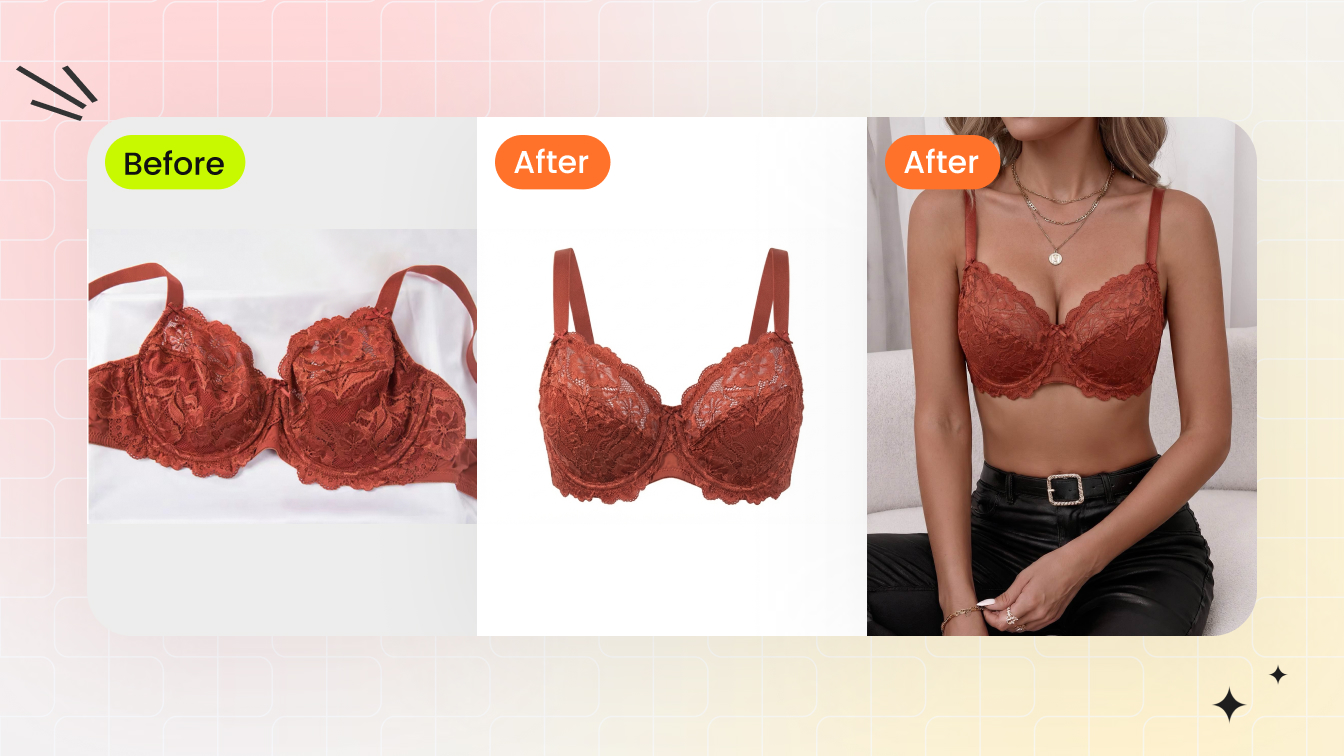
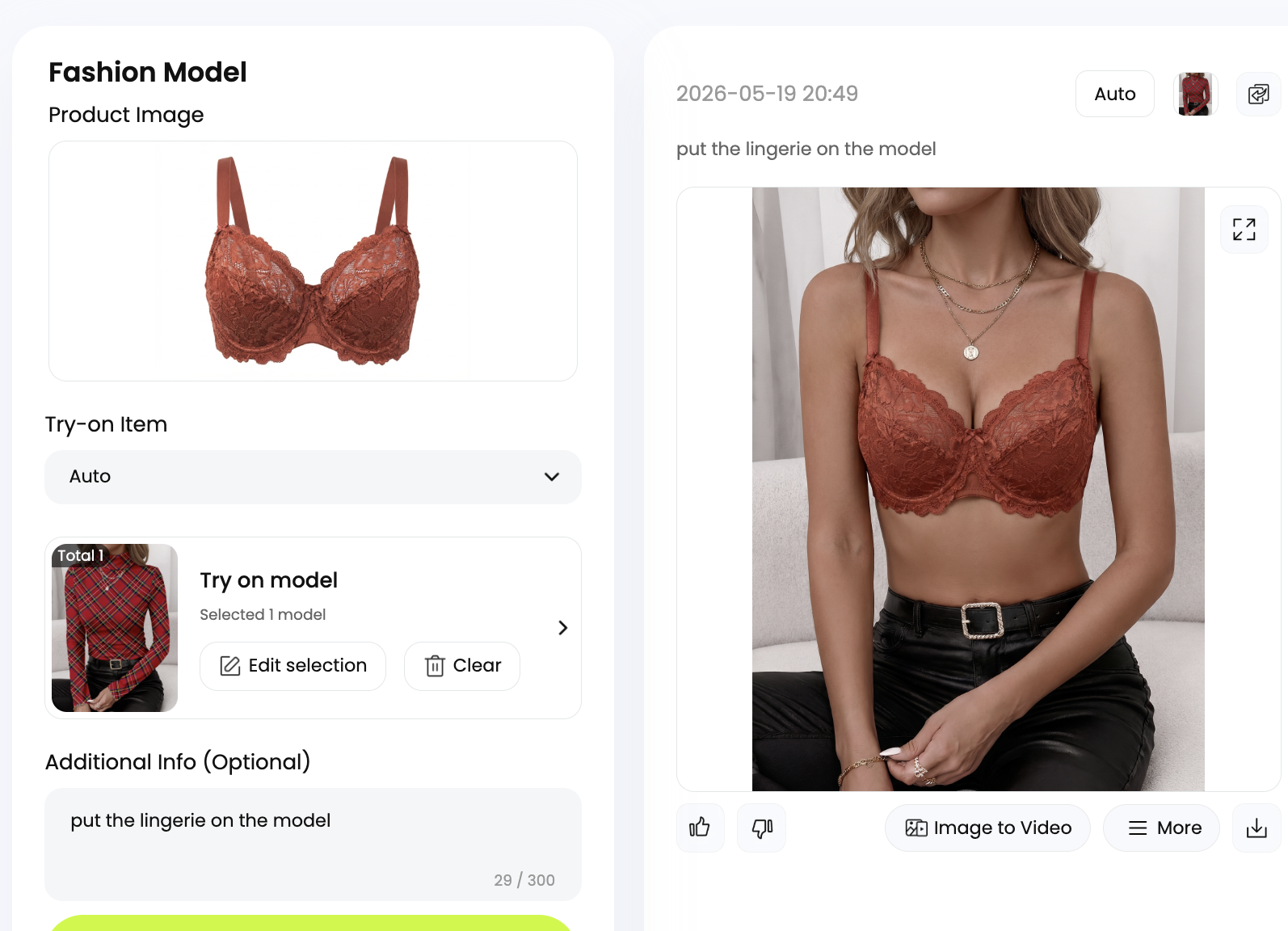
- Generate platform-spec outputs through AI. Snappyit AI Fashion Model can output on-body images at Amazon spec (1:1 white background) and Shopify spec (4:5 vertical) from the same flat-lay input.
- Generate ghost-mannequin output for the Amazon main image. AI ghost mannequin handles the spec automatically.
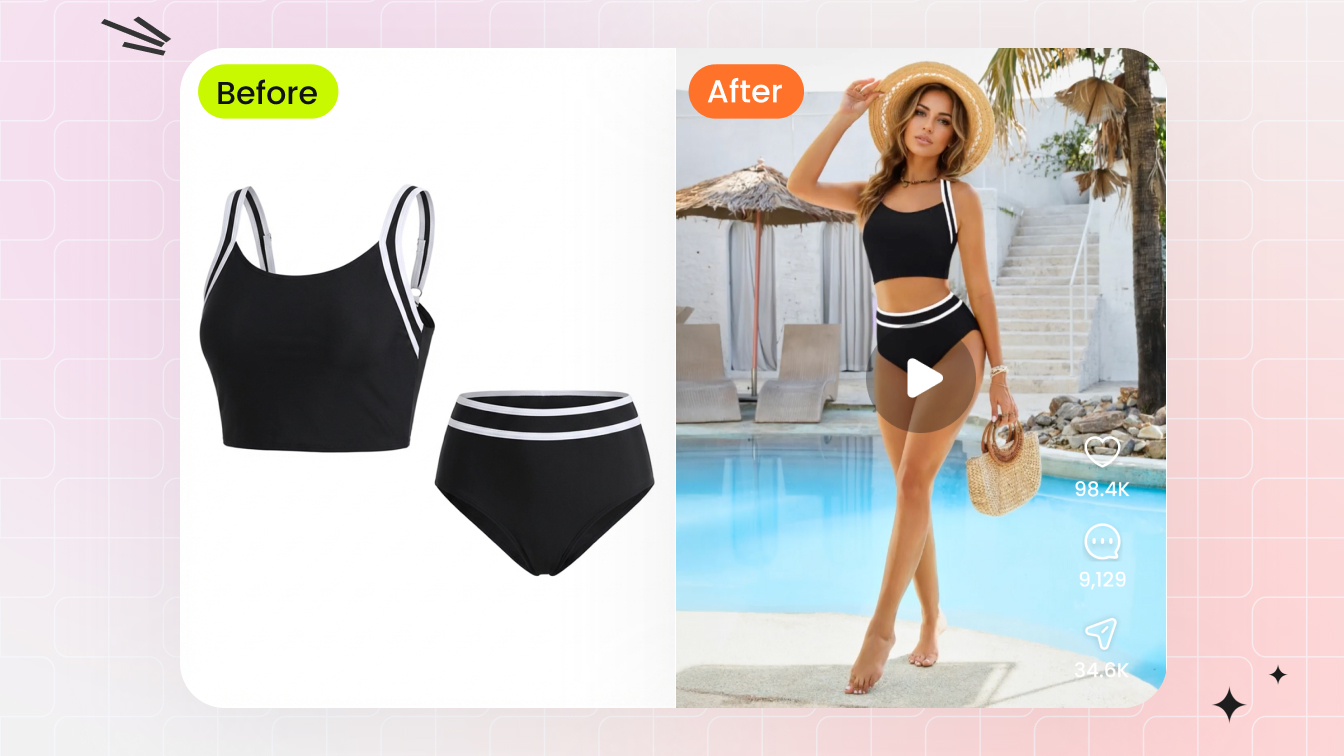
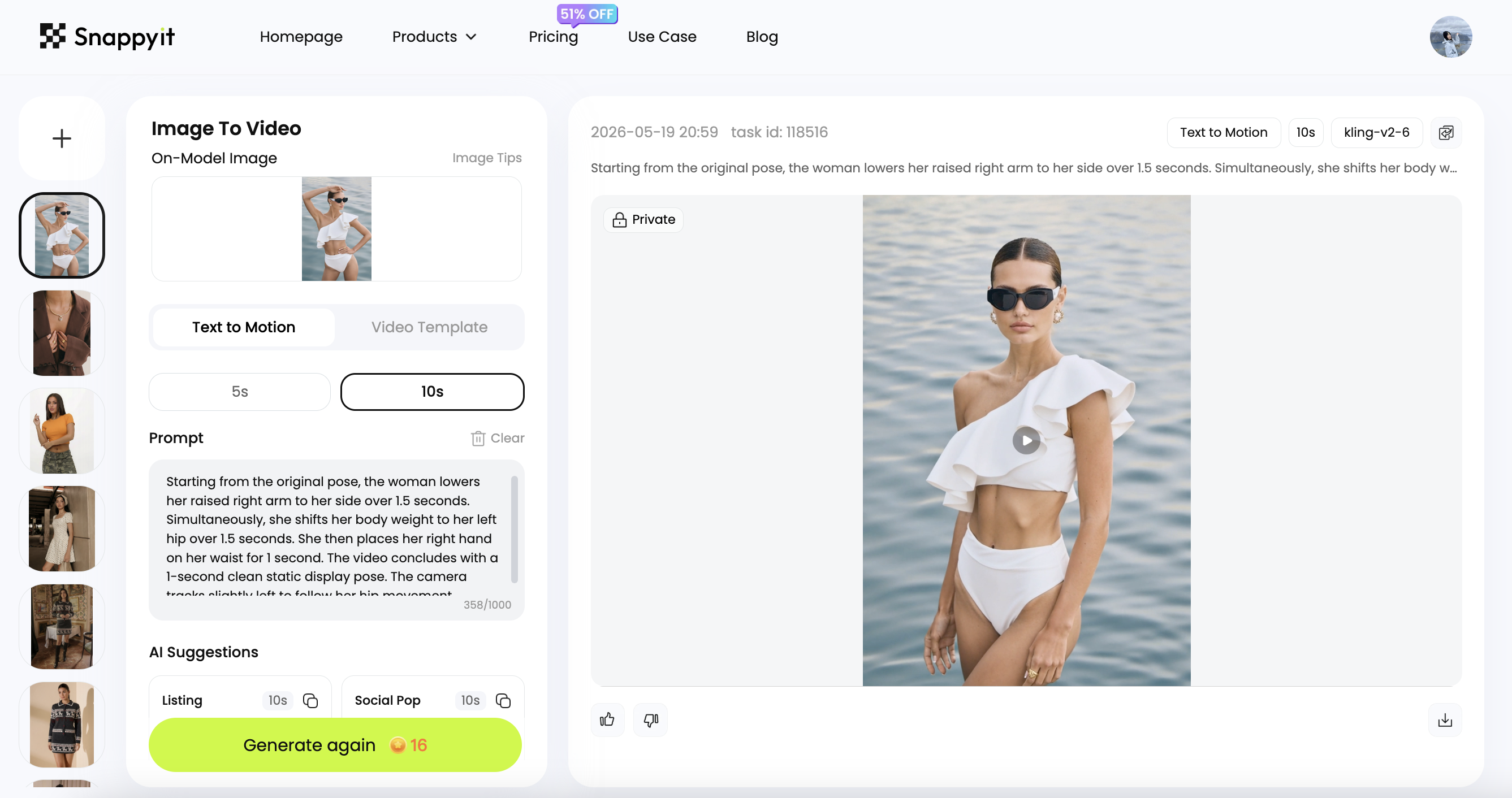
- Generate motion video for TikTok and Reels. AI fashion video converts the on-body image into 9:16 motion.
For deeper coverage of the photo workflow including ghost-mannequin techniques, see how to photograph swimwear without a model and swimwear flat-lay photography.
Try the marketplace-ready tool first. Generate Amazon main images, Etsy lifestyle photos, and Shopify hero shots from one flat-lay with Snappyit's swimwear pipeline.
Pricing, Margins, and Fees
Realistic 2026 pricing structure for a mid-tier swimwear brand:
- Manufacturing cost — $8-25 per piece for two-piece sets, $12-35 per piece for one-pieces, depending on fabric and production country.
- Retail price — typical 4x-6x manufacturing for indie brands, 3x-4x for volume sellers. So $40-150 retail for a $10-25 cost piece.
- Platform fees — Etsy 6.5% transaction + 3% payment + listing fees (~12% total). Amazon 15% category fee + FBA fees. Shopify 0-2% transaction (depending on plan) + payment processing 2.9%+30¢.
- Returns — budget 30-35% return rate for swimwear (industry average for apparel is 25%; swimwear and lingerie are the highest-return categories). Hygiene-sealed packaging and clear sizing photos reduce returns.
- Marketing — typical 15-30% of revenue at growth stage, 5-12% at mature stage.
Net margin target: 20-35% at mature scale. Below 15% net margin means you cannot fund growth or absorb returns.
Marketing After Launch
Listings live is the start, not the finish. The marketing channels that consistently work for 2026 swimwear brands:
Instagram and TikTok Organic
Post product photos and short videos consistently. The 9:16 motion video output from AI fashion video tools makes daily content production feasible without a daily shoot.
Influencer Collaboration
Send free product to micro-influencers (10K-100K followers) in your niche. Conversion from micro-influencer posts often outperforms mega-influencers because their audiences trust their recommendations more.
Email Marketing
Build a list from day one. Welcome series, abandoned cart, post-purchase, and seasonal launch flows drive 25-40% of revenue at mature scale.
Pinterest is undervalued for swimwear. The platform's audience demographics (women, planning, lifestyle) align with the buyer persona. Pin every listing with multiple aspect-ratio variants.
Paid Ads
Meta and TikTok ads at launch ($20-50/day) to gather data and seed retargeting audiences. Scale spending only after you have a positive ROAS proven over 30+ days.
2026 Swimwear Seasonality and Inventory Planning
Verified 2026 seasonality data shapes the calendar for any new swimwear seller:
- Peak season: April-June captures 48% of annual unit sales, with May the peak month for women's swimwear specifically.
- Pre-spring break (January-March): First demand wave driven by tropical vacation planning and cruise bookings. Roughly 18-22% of annual sales.
- Late season (July-September): Replacement buying and end-of-season sales, plus early cruise prep. Roughly 20-25% of annual sales.
- Off-season (November-February): Cruise and winter-getaway demand, skewing older and more affluent. Roughly 10-15% of annual sales.
- Returns peak: 80% of swimwear returns happen April-August, with June at 22% the single-highest month. Return processing capacity needs to spike in that window.
Practical implications: inventory needs to be live by mid-February to catch the spring-break wave. Photo content should be ready by late January for marketplace listings to start ranking before peak. Return-handling staffing and policy need April-August preparation.
Amazon 2026 Swimwear Compliance Deep Dive
Amazon's 2026 main image policy for adult clothing has tightened in ways that directly affect swimwear sellers:
- Main image must be live model OR ghost mannequin technique (mannequin removed in post). Flat-lay, hanger, or mannequin-visible images are not accepted as the main image for adult apparel.
- Children's and baby swimwear is different — flat-lay is preferred, and live models are restricted for the main image.
- Pure white background, RGB 255,255,255 — not off-white or near-white.
- Product fills at least 85% of frame.
- Resolution: 1000px minimum on longest side, 2000-3000px recommended in 2026 for retina-display compatibility and zoom function.
- Maximum file size 10MB. Accepted formats: JPEG, PNG, TIFF, non-animated GIF.
- No text, logos, watermarks, borders, or inset images in the main image.
AI-generated imagery is acceptable under Amazon's 2026 AI policy with these constraints: the AI image must accurately represent the physical product; substantial AI generation (virtual model on a synthetic background) should be disclosed in the product description; minor AI retouching (background removal, color correction, lighting adjustment) does not require disclosure.
The bottom line on how to sell swimwear online
The single biggest 2026 shift in how to sell swimwear online is that the photography cost has collapsed. Five years ago, a small swim brand needed $5,000–$15,000 in shoot costs before a single listing went live; in 2026, the same brand ships marketplace-ready imagery on a sub-$200 setup plus AI fashion model credits under $30 a month. That cost compression changes the breakeven math on every category — the brands that sell swimwear online profitably in 2026 are the ones who reinvest the saved photo budget into either inventory depth or marketing spend, not the ones that still treat photography as the major content line item.
For first-time sellers learning to sell swimwear online, the playbook is: Etsy for product validation (lowest commit, fastest feedback), Shopify for brand-building (once you have 50+ repeat-purchase units), Amazon for scale (once your product has a verifiable return rate under the category average), and TikTok Shop for trend-driven micro-drops (whenever you have a piece that fits a short-form video angle). The sellers who sell swimwear online and win in 2026 do not run all four platforms simultaneously from day one — they sequence into them as inventory, content, and brand mature.
Whichever path you take to sell swimwear online, the Amazon compliance checklist below is the single hardest gate to clear. Resolve every line item before launch; getting the first listing through clean review is worth more than launching faster on a sub-compliant photo set.
Amazon Swimwear Listing Compliance Checklist 2026
The 2026 Amazon adult-apparel rules tightened in ways that catch many swimwear sellers off-guard. Use this checklist before pressing publish:
- ✓ Main image is live model OR ghost mannequin (mannequin removed). Flat-lay, hanger, dress form, mannequin-visible — all are rejected for the main slot on adult swimwear.
- ✓ Background is pure white RGB 255,255,255 — not near-white, not gradient, not cream.
- ✓ Garment fills at least 85% of the frame.
- ✓ Image is 2000-3000px on longest side (1000 minimum, but 2000+ is the 2026 best practice for retina compatibility).
- ✓ JPEG, PNG, TIFF, or non-animated GIF. Max 10MB.
- ✓ No text, logos, watermarks, borders, or inset images on the main image.
- ✓ If imagery is AI-generated, accuracy disclaimer in product description per Amazon's 2026 AI policy.
- ✓ All 9 secondary image slots filled — on-body lifestyle, scale reference, fabric close-up, color variant grid, fit detail, and at minimum one flat-lay.
- ✓ Optional product video (6-30 seconds, 1080p+) — conversion lift 20-40% when present.
Etsy 2026 SEO Tactics for Swimwear
Etsy's search algorithm rewards specific listing structure for swimwear in 2026:
- Title structure — primary keyword in first 40 characters. Etsy weights early-position keywords more heavily. "High-waisted bikini set, tropical print..." beats "Beach vacation outfit, high-waisted bikini..."
- Tag exhaustion — fill all 13 tags with distinct keywords. Tag synonym variants ("bikini," "two-piece swimsuit," "swim set") even when the keyword density feels redundant.
- Description first paragraph — Etsy displays the first 160 characters in search results. Lead with the strongest selling point, not "thank you for visiting my shop."
- 7+ photos minimum — Etsy data shows listings with 7+ photos consistently outperform fewer. Photo slot 1 is the most important — the conversion-decisive image.
- Video — Etsy allows one video per listing (5-15 seconds, max 100MB). Listings with video convert 30-50% better than photo-only on swimwear specifically.
- Renewal cadence — listings get a freshness boost when renewed. Many swimwear sellers renew weekly during peak season (April-June) and biweekly off-peak.
Shopify Swimwear Store Build Specs 2026
For sellers building or rebuilding a Shopify swimwear storefront in 2026, the spec choices that matter:
Product Image Configuration
- 2048×2048 px square is the Shopify-recommended primary size (per their 2026 guidance).
- WebP at 80-85 quality for the right balance of size and visual fidelity.
- 800×800 minimum for the built-in zoom feature; below that, zoom does not engage.
- 5-8 images per product, with the first image being the on-body or ghost-mannequin primary, supporting images flat-lay, detail, and variants.
- Hero video (mp4, 1080p+) auto-plays on product page; converts particularly well on swimwear.
Theme Choice for Swimwear
Image-heavy themes outperform text-heavy themes for swimwear. Themes with full-bleed hero sections, large product galleries, and prominent "above the fold" buy buttons drive higher conversion. Avoid themes built for B2B or service businesses.
TikTok Shop Swimwear Tactics
TikTok Shop in 2026 rewards video-first listings for swimwear specifically. Product card image spec:
- Minimum 600×600, recommended 800×800, JPEG or PNG, max 5MB.
- Up to 9 product images.
- Video at 1080×1920 (9:16 vertical), MP4 or MOV, max 500MB.
- Video length 15-60 seconds for product content; the first 3 seconds need to grab attention or the algorithm de-prioritizes.
Swimwear that performs on TikTok Shop typically has movement — a model walking on sand, tying a halter, splashing water. Static flat-lay product cards underperform video cards by 40-60% in TikTok Shop's ranking algorithm. Sellers using AI Fashion Video can generate the required 9:16 motion content from a static on-body image, closing the production gap that previously made TikTok Shop hard for solo sellers.
Size Inclusivity as a 2026 Conversion Lever
Buyer expectations across all platforms in 2026 require size range from XS through 4X or larger as a baseline. Brands shipping only standard sizing (XS-XL) see depressed conversion rates and return rates 5-10 percentage points higher than size-inclusive competitors. The reason: 42% of returns cite size/fit, and buyers who could not find their size in the listed range are buying up or down and returning.
The photography implication: each size range needs visual representation. AI fashion model tools that support multiple body-type templates from the same flat-lay let brands publish size-inclusive imagery without running a multi-model shoot per SKU. Snappyit's body-type template library includes plus-size, athletic, petite, and tall variations that can be applied to any source flat-lay, generating a 4-body-type variant set in under 5 minutes per SKU.
Influencer Collaboration for Swimwear in 2026
Influencer marketing remains a primary channel for swimwear brand growth in 2026, but the playbook has shifted. The 2024 default ("pay a mega-influencer for one post") has been replaced by the 2026 default ("seed product to 50-200 micro-influencers, optimize for organic UGC").
- Micro-influencers (10K-100K followers) — best CPM and conversion in 2026. Conversion from micro-influencer posts often outperforms mega-influencers because audience trust is higher.
- Free product seeding — send the actual swimwear in exchange for posts. Budget the wholesale cost (≈ $15-25 per piece) as the marketing cost.
- Affiliate codes with attribution — give each influencer a unique promo code so you can track ROI per relationship.
- UGC repost permissions — secure rights to repost the influencer's content as paid social ads. This compounds the value of each seeded piece.
- Niche match over reach — a 20K-follower body-positive influencer beats a 500K lifestyle influencer for a curve-fit swimwear brand. Match audience to product.
Returns Handling: The Operational Layer
Swimwear's 30-35% return rate makes return handling a core operations function, not an afterthought. Practical 2026 setup:
- Hygiene seal liner — required by most marketplace policies, kills the "tried and returned dirty" problem. Adds $0.10-0.30 per unit but cuts returns of used items dramatically.
- Free returns or paid returns — free returns lift conversion 8-15% but absorb the return shipping cost. Paid returns ($5-8 deduction from refund) reduces conversion but discourages bracketing.
- Return window — 30 days standard. Shorter (14 days) reduces returns but hurts conversion. Longer (60+) drives bracketing.
- Size/fit return reason analysis — log return reasons by SKU. If one SKU has a 50% return rate while others are 25%, the SKU has a sizing chart problem, not a customer problem. Fix the sizing chart and returns drop on that SKU within 30 days.
- Restocking inspection — items returned with tags intact and hygiene seal in place restock as new. Items without get marked down or written off.
Frequently Asked Questions About Selling Swimwear Online
1. How much capital do I need to start a swimwear brand in 2026?
With print-on-demand: $0-500 to validate designs. With small-batch inventory: $2,000-5,000 for first 100-200 units across SKUs. With premium full-collection inventory: $15,000+. Add $500-2,000 for photography (AI tools have dropped this dramatically) and $1,000-3,000 for initial marketing.
2. Do I need to be in the US to sell on Amazon and Etsy?
No. Both platforms support sellers from most countries. Tax registration, payment processing, and shipping logistics differ by country; check the seller eligibility pages for current rules.
3. How do I handle sizing across markets with different size standards?
Build a comprehensive size chart with both numeric size and body measurements (bust, waist, hip in inches and centimeters). For international markets, include conversion notes (US/UK/EU/Japan equivalents). Returns due to sizing drop sharply when you publish accurate body measurements.
4. Can I use AI-generated photos for legitimate ecommerce listings?
Yes, when the AI image accurately represents the actual product being sold. Major platforms (Amazon, Etsy, Shopify) accept AI imagery as of 2026 with the caveat that the garment shown must match the garment shipped. Avoid AI images that misrepresent fit, color, or features.
5. What's the fastest way to launch a swimwear store with zero photo budget?
Phone flat-lay your sample inventory in good window light. Run each flat-lay through AI Fashion Model and AI Ghost Mannequin to generate on-body and white-background versions. Build your Shopify or Etsy store with these AI-enhanced photos. Total time from samples in hand to live listings: under one weekend.
Generate your first marketplace-ready swimwear image in 90 seconds
Get Amazon-spec main images, Etsy lifestyle shots, and Shopify hero photos from one flat-lay. Snappyit handles model, ghost mannequin, color variants, and video from a single source image.
Try Snappyit AI Fashion Model free →