




A useful AI product photography workflow has to do more than generate one polished image. It should turn the same real product into a consistent flat lay or ghost-mannequin view, verified color variants, an on-model image, and social-ready motion—without changing the SKU details between assets.
To keep this guide grounded in real output, I reviewed five fashion product photography workflows in Snappyit: flat lay, ghost mannequin, product recolor, fashion model, and image to video. The examples were generated between February 10 and July 14, 2026; each figure below shows its actual generation date. I compared the source and generated assets for product shape, color, fabric details, model artifacts, and whether the files were practical for a listing or social workflow. These are five workflows within one platform, not a multi-vendor ranking.
For an ecommerce merchant, the useful question is therefore not simply “Can AI create a product image?” It is “Can my team turn the same real product into an accurate listing set and a week of on-brand content without losing the SKU, changing product details, or adding another approval bottleneck?” This guide shows how to build a small AI product photography stack, add it to the current listing process, and reuse approved product images for social media. The aim is not to replace every photoshoot. It is to publish more products and more creative while keeping the catalog trustworthy.
Test note: The quality conclusions below are qualitative visual assessments of one example per workflow. They are not a multi-sample benchmark, and the cost figures use the credit requirements shown for each workflow at the time of this review.
What Is AI Product Photography?
For ecommerce merchants, AI product photography is a production layer that turns real product inputs into the image formats needed for listings, campaigns, and social channels. It includes simple editing as well as category-specific work that once required a studio or a long retouching queue.
In practice, that can mean:
- turning an apparel photo into a consistent flat lay;
- creating a ghost-mannequin view that shows garment structure;
- placing clothing or jewelry on an AI model;
- generating color variants while preserving material details;
- building channel-specific lifestyle scenes and campaign formats;
- producing crops, aspect ratios, and localized creative variants from an approved master asset.
The important part is what happens around the generation. A useful AI setup keeps the product connected to its SKU, sends the output through a clear review step, and exports the right file for the right channel.
Product source → task-specific AI transformation → human QA → approved master asset → listing or social media derivative → channel delivery
Keep three versions of product truth
Do not let every new AI image become an unofficial “master.” Keep three clear asset layers so the listing team and marketing team always know what they can trust and what they can change.
| Asset layer | Purpose | Typical examples | Product-truth rule |
|---|---|---|---|
| Source assets | Record what the real product actually looks like | Raw front, back, side, label, texture, hardware, and color-reference photos | Must remain linked to the physical SKU and should never be overwritten |
| Listing assets | Help a shopper evaluate the exact item being sold | White-background hero image, flat lay, ghost mannequin, model view, detail crop, color variant | Must accurately represent the SKU and pass channel-specific review |
| Social media derivatives | Adapt an approved product for a channel, campaign, or audience | Lifestyle scene, ad creative, social crop, short video, seasonal background, localized post | May be more creative, but must inherit the approved product representation and claims |
This separation solves a common merchant problem: a lifestyle image looks great in an ad, then quietly becomes the reference for the product page even though the color, fit, hardware, or construction has changed. Approve the listing representation first. Let marketing create from that approved asset rather than starting again from an old supplier photo.
Build a small stack around repeatable jobs
You do not need the longest software list. You need a dependable tool for each job that repeatedly slows down your catalog or content calendar.
| Stack layer | Job in the workflow | Possible outputs |
|---|---|---|
| Capture and asset layer | Collect, identify, and store real product inputs | Raw photos, SKU folders, shot lists, product attributes |
| Accuracy layer | Clean and standardize while preserving the item | Background removal, lighting correction, cleanup, consistent framing |
| Category-production layer | Create views that require knowledge of the product type | Flat lays, ghost mannequin, apparel models, jewelry models, retouching, recolors |
| Creative layer | Adapt approved products for campaigns and channels | Lifestyle scenes, concepts, ad variations, crops, localized formats |
| QA and delivery layer | Review, version, export, and publish | Approval status, rejection reason, file naming, channel-ready files, DAM/PIM records |
One platform may cover several layers, while a specialist may be much better at a difficult category task. Your best stack might be three tools connected by one simple SOP. What matters is that every recurring job has a clear input, owner, review rule, and approved destination.
The Three Reasons AI Product Photography Fails for Ecommerce
In a fashion ecommerce workflow, three recurring failure modes are: merchants rely on prompt-heavy general AI, receive files that are not ready for their sales channels, or add one isolated tool without fixing the full production workflow.
1. General AI tools depend too much on prompts
General image generators can make impressive pictures, but getting a usable ecommerce result often requires repeated prompt writing, regeneration, and manual correction. That may be acceptable for one campaign concept, but it can be difficult to scale consistently across a large catalog.
The most common problems are:
- product details such as stitching, logos, hardware, prints, or proportions are changed;
- lighting, framing, models, and backgrounds vary from one SKU to the next;
- a prompt that works once does not reliably reproduce the same result for the rest of the catalog.
Ecommerce production needs repeatable presets and category-aware tools, not a new prompt experiment for every product.
2. The output is not ready for ecommerce or social platforms
An AI image can look good and still be impossible to publish. Listing and social channels each have their own requirements for background, crop, aspect ratio, resolution, file size, text placement, and video format.
For example, a marketplace main image may need a clean product-only view, while Instagram Reels and TikTok short-form placements commonly prioritize vertical creative with important content inside safe areas [3][4]. Other placements support different formats, so teams should check the current specification for the exact placement. AI video also needs stable product details, logos, and text from the first frame to the last.
Use products designed for ecommerce production. They should help the team preserve product accuracy and create channel-ready listing images, social ratios, and video formats without rebuilding every asset by hand.
3. One AI tool does not improve the whole team workflow
A single tool may make one editing task faster, but the team can still lose time finding source files, renaming downloads, checking product details, requesting missing variants, and exporting the same image again for different channels.
The larger efficiency gain comes from connecting the right tools into one repeatable stack:
SKU source photos → category-specific AI tools → product QA → listing and social exports → publish
The goal is not to find one tool that does everything. It is to give each recurring job the right tool and connect those tools to the team's existing approval and publishing process.
How to Build an AI Product Photography Workflow for Ecommerce Listings
Listing images have one commercial job: help shoppers understand the exact product well enough to buy it. For the merchant, they also need to arrive in a predictable set that can be reviewed and published for every SKU.
Do not judge listing AI by how dramatic the first result looks. Judge it by whether the image is consistent, accurate, accepted by the sales channel, and easy to repeat across the catalog.
| Requirement | What it means in practice | Workflow rule |
|---|---|---|
| Consistency | Products use predictable angles, framing, scale, backgrounds, shadows, and gallery order | Define image templates by category and channel before generation |
| Accuracy | Color, silhouette, fabric, construction, print, hardware, and proportions match the real SKU | Compare every generated asset with the source-of-truth package |
| Platform compliance | Each image fits the rules of its marketplace, storefront, and image slot | Store channel specifications in the export preset and review checklist |
| Scalable production | The team can repeat the process across a large catalog without uncontrolled manual work | Use standardized inputs, batchable tasks, naming rules, approval states, and rejection reasons |
An attractive image that fails one of these checks is still a draft, not a listing asset.
Plan the gallery before generating anything
Start with the gallery a shopper should see, not the features a tool offers. For every image slot, decide:
- Which channel will receive the asset?
- Which image slot will it fill?
- What shopper question should that slot answer?
- Which product details must remain unchanged?
- What background, crop, dimensions, file format, and file size are required?
- Who approves the image, and what happens when it fails?
For an apparel merchant, a practical gallery plan might look like this:
| Listing job | Shopper question | Recommended AI capability | Main QA focus |
|---|---|---|---|
| Clean catalog or hero view | What exactly is the product? | AI flat lay or AI ghost mannequin | Shape, proportions, construction, background, framing |
| Structured garment view | How does the garment hold its shape? | AI ghost mannequin | Neckline, sleeves, openings, drape, front/back structure |
| Color-variant image | What does this exact variant look like? | AI recolor | Verified color, texture, print, stitching, hardware |
| On-body secondary image | How can shoppers visualize its styling and approximate on-body presentation? | AI fashion model | Garment identity, apparent length, drape, body placement, model artifacts |
| Detail evidence | Are the material and construction trustworthy? | Original close-up or accuracy-preserving retouching | Labels, seams, fasteners, texture, condition |
Not every SKU needs every image type. Choose the tools that answer the selling questions for your category and channel rather than forcing the same gallery template onto every product.
AI Flat Lay: Standardize Product Photos from Any Source
AI flat lay is a practical starting tool for apparel when product inputs arrive from different suppliers, phones, studios, or team members. It turns that mixed source material into a repeatable overhead catalog view.
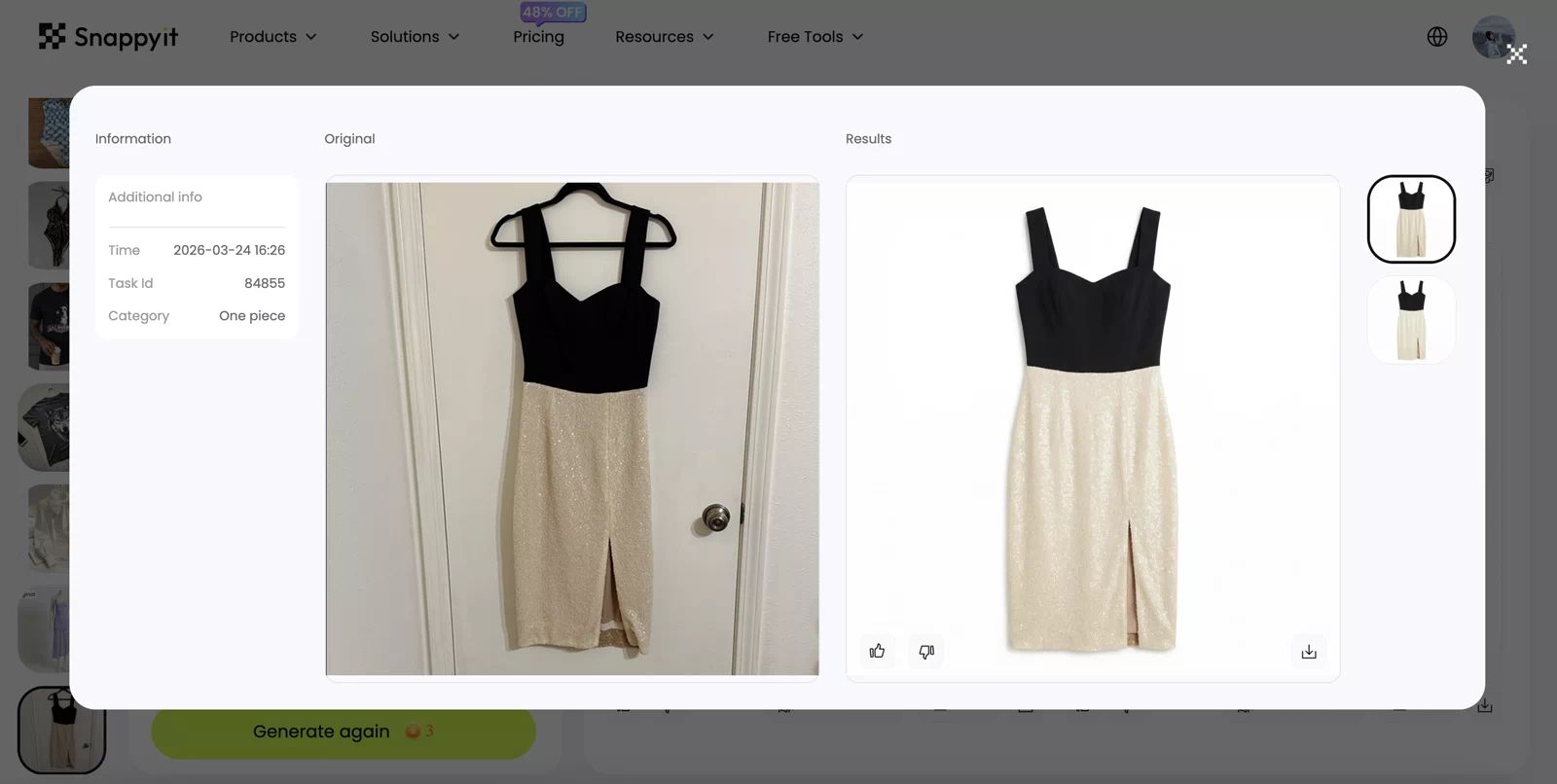
Product fidelity: Good. The black bodice, champagne skirt, straps, and front slit remain recognizable. The neckline, edge symmetry, and sequin texture are visibly cleaned, so those details still need source comparison.
Image clarity: High. The product has clean separation and sharp catalog edges, although some fine fabric texture appears smoothed.
Realism: Medium-high. The white studio presentation is believable, but the shadowing and symmetry look more polished than a natural capture.
Generation cost: $0.15 per image (3 credits × $0.05).
Best for: apparel sellers, resellers, and high-SKU stores that need a consistent hero or supporting image without reshooting every item.
Use it to:
- isolate the product from a distracting source background;
- normalize the top-down angle and placement;
- create consistent spacing and framing;
- clean minor wrinkles and lighting differences;
- produce a reusable base image for the gallery or downstream transformations.
Compare the result with the real item around hems, straps, collars, pockets, prints, and asymmetrical details. A cleaner presentation should never become a redesigned product.
AI Ghost Mannequin: Show Garment Shape Without a Model
AI ghost mannequin helps apparel shoppers understand silhouette and structure while keeping the image focused on the garment. It is useful when a flat lay looks shapeless but a full model image would distract from the product.
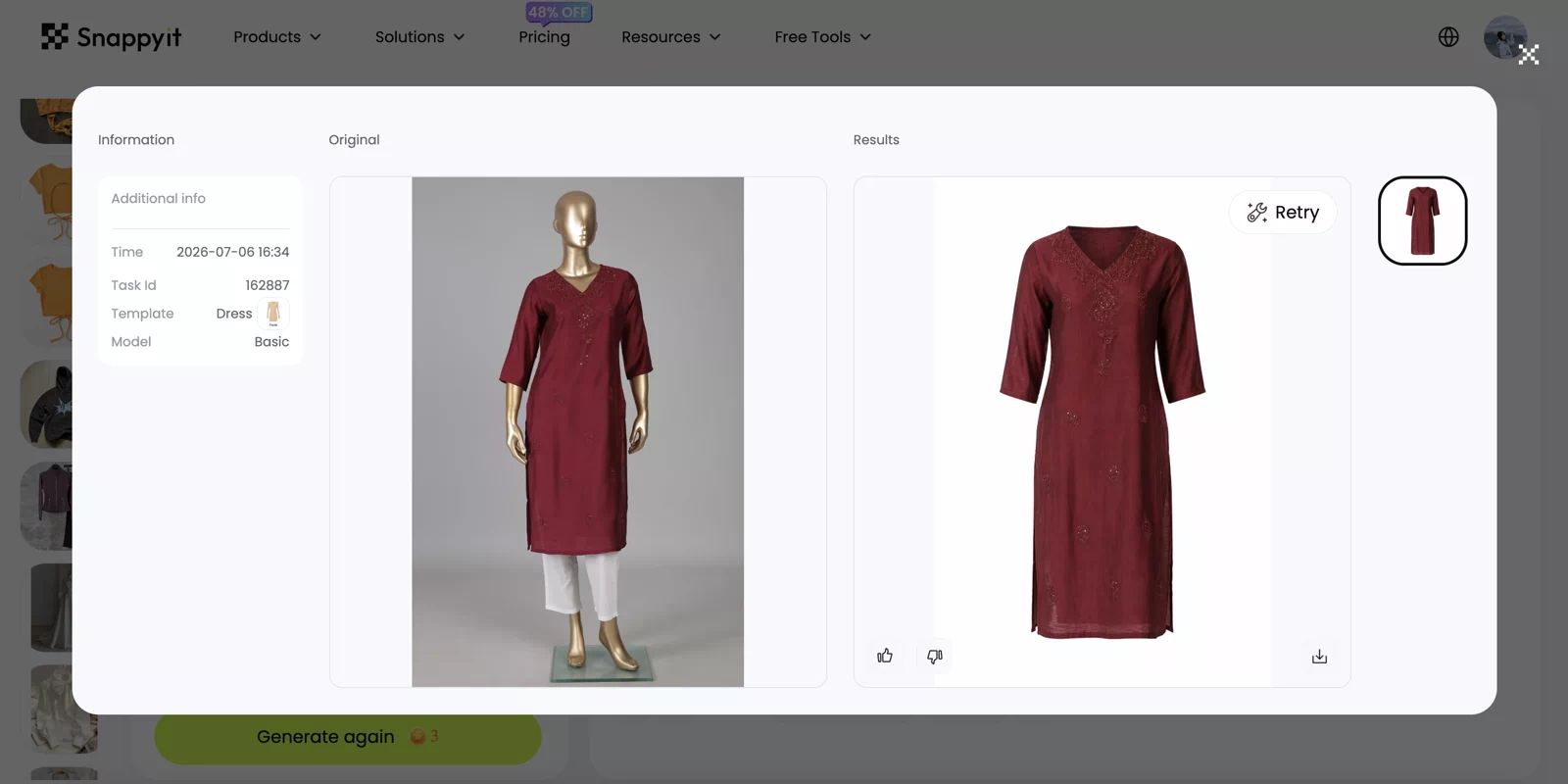
Product fidelity: Good overall. The burgundy color, V-neck embroidery, sleeve length, and long tunic silhouette remain identifiable. Because the AI reconstructs drape and hidden areas after removing the mannequin, width, hem, and inner-neckline details need review.
Image clarity: High. The garment edge and major embroidery remain easy to inspect against the clean background.
Realism: Medium-high. It works as a clean ghost-mannequin catalog view, although the hollow neckline and reconstructed drape can look slightly synthetic.
Generation cost: $0.15 per image (3 credits × $0.05).
Best for: dresses, shirts, jackets, knitwear, and other garments where neckline, volume, openings, and drape affect the purchase decision.
This is more than background removal. The AI reconstructs a worn shape, so review these areas carefully:
- verify the neckline, inner collar, armholes, sleeves, and hem;
- confirm that garment length and width have not changed;
- check closures, pockets, lapels, straps, and layered areas;
- reject invented interior fabric or impossible folds;
- use front and back source references when those views matter.
Depending on the channel, use the approved result as the clean main view or as a supporting image next to the original detail shots.
AI Product Recolor: Create Color Variants Without Reshooting
AI product recolor lets a merchant create a consistent image set for multiple colorways from one approved master. It can reduce a launch delay when the construction is identical but photography for every variant is not ready.
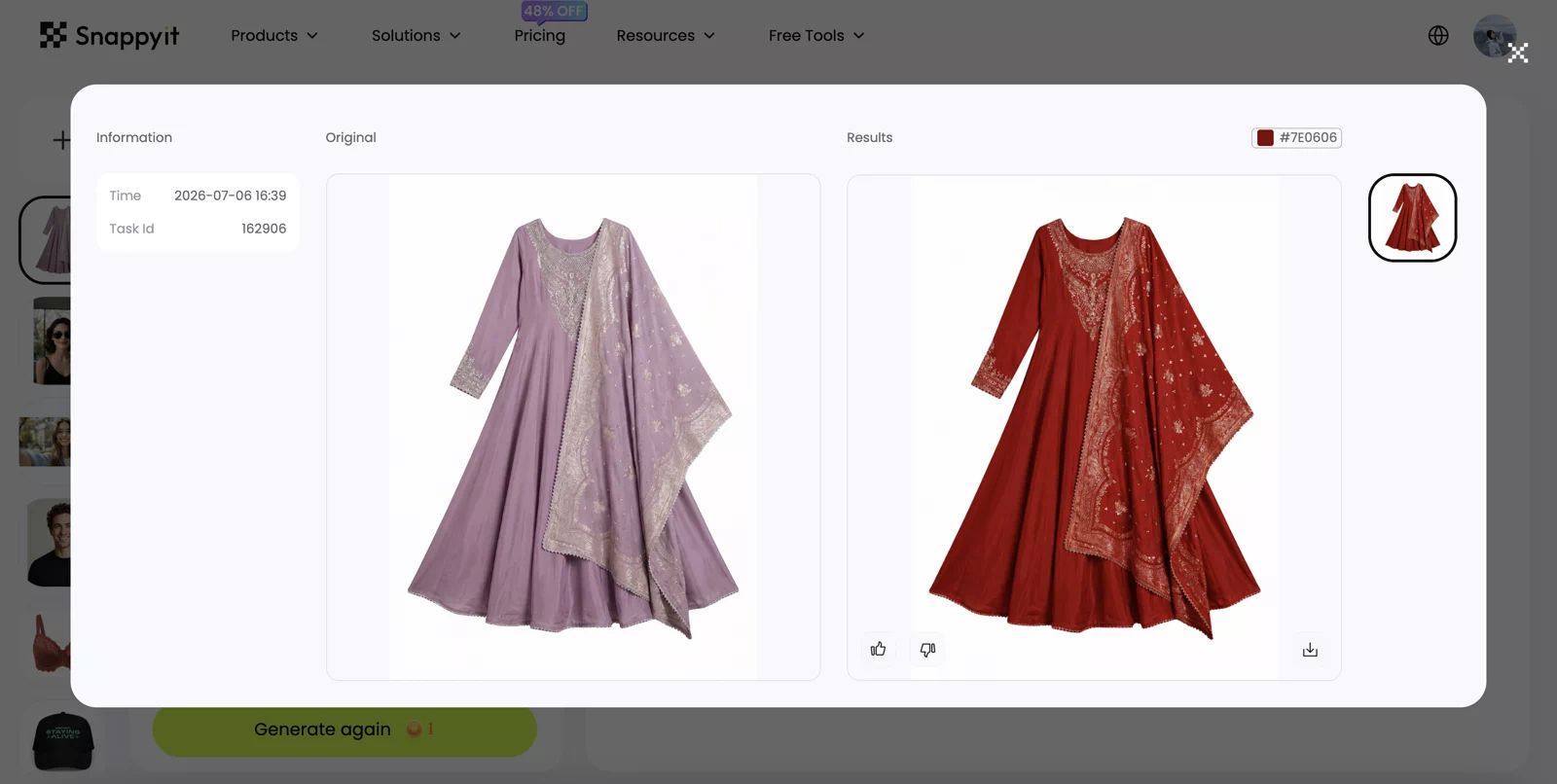
Product fidelity: Good for silhouette and embroidery placement. The target color is applied consistently, but color accuracy cannot be verified from a screenshot or HEX value alone; gold accents and fabric texture should be checked against a physical swatch or calibrated reference.
Image clarity: High. Construction and decorative details remain visible, with some tonal compression in the deepest red areas.
Realism: High as a catalog visualization. Whether the red matches the physical colorway remains unproven until color QA is completed.
Generation cost: $0.05 per image (1 credit × $0.05).
Best for: products sold in many verified colors, especially when the base material, construction, and trim stay the same.
Start with product data, not a creative color prompt. The workflow needs:
- an approved base image;
- the exact variant/SKU relationship;
- a physical swatch, calibrated reference photo, or verified color value;
- rules for elements that must not change, such as buttons, metal, labels, prints, or contrast stitching;
- a side-by-side color and texture review before publishing.
Do not use recolor to invent a color you do not sell or to hide real material differences between colorways. Each output must stay attached to the correct variant SKU.
AI Fashion Model: Add On-Body Context at Catalog Scale
AI fashion model shows how a garment or accessory may look on a person without booking a new shoot for every SKU. Use it after the product-only master is approved, usually as a secondary PDP image or styling view.
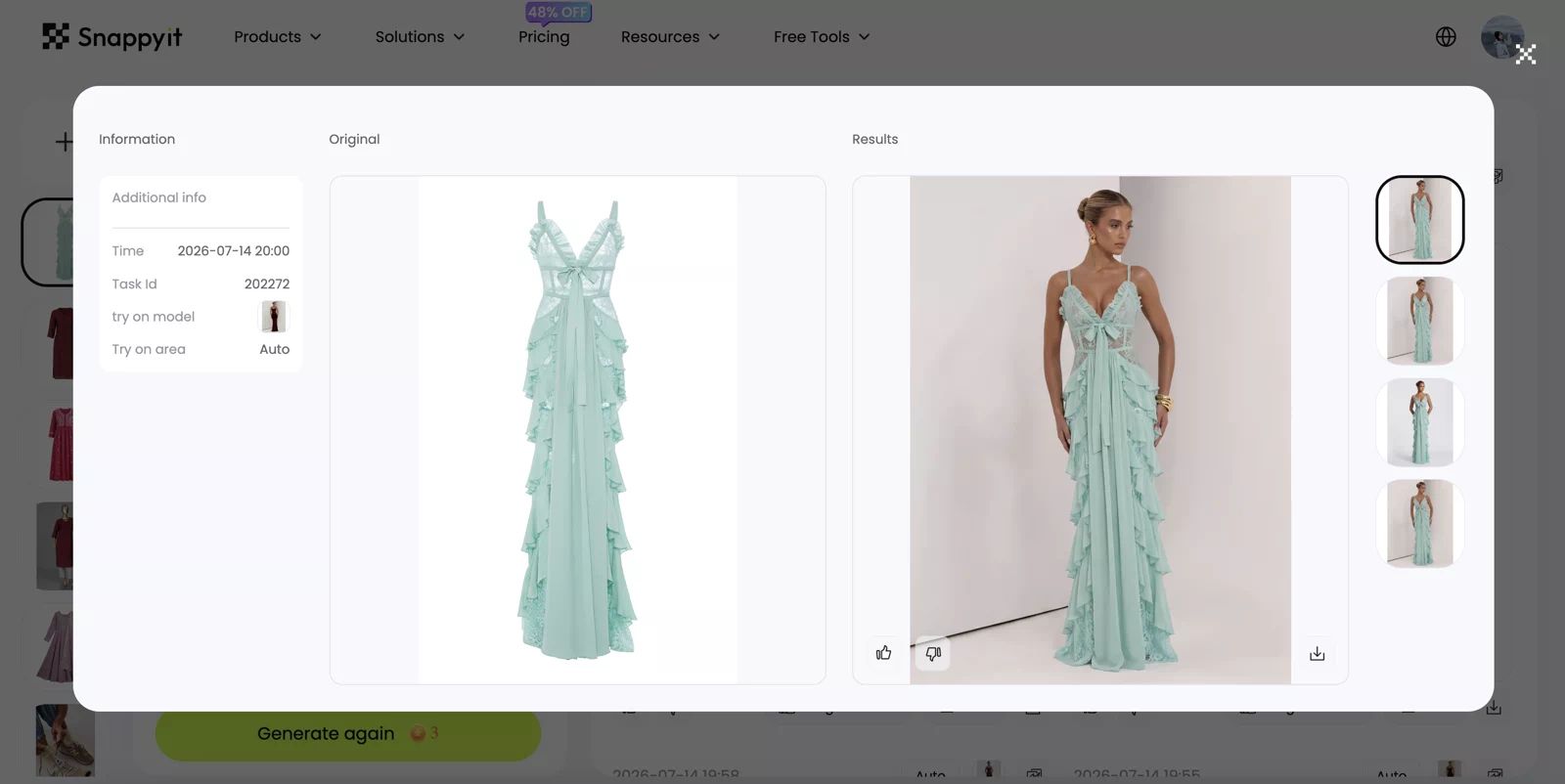
Product fidelity: Good overall. The mint color, ruffles, front bow, and long silhouette remain recognizable. The neckline, layer overlap, apparent length, and drape are reconstructed and should not be treated as evidence of actual fit.
Image clarity: High. The dress is sharp enough for a PDP secondary view, although lace, thin straps, and other fine details should be checked at full resolution.
Realism: High at normal viewing size. The model and studio lighting look convincing; hands, skin-to-garment contact, and overlapping fabric remain the priority areas for zoomed QA.
Generation cost: $0.15 per image (3 credits × $0.05).
Best for: fashion stores that need visual styling and approximate on-body context across frequent drops or multiple target audiences. Generated model images are not evidence of actual garment fit or sizing.
Create a small set of reusable model profiles instead of choosing a new face, body, pose, and environment every time. A controlled model library can make the catalog feel more consistent and give reviewers a repeatable approval baseline.
QA should focus on:
- whether the uploaded garment remains the same product;
- apparent length, drape, placement, and coverage;
- the placement of prints, logos, pockets, straps, and accessories;
- hands, hair, and body areas that overlap the product;
- consistency of model style across the collection;
- whether the chosen image slot and channel permit the format.
AI model photography adds context; it should not be the only evidence of what the customer will receive. Keep product-only and detail images in the gallery.
Fit the AI Product Photography Tools into Your Listing Workflow
The tools start saving time only when the outputs move through the same launch process as the rest of the SKU. A merchant-friendly sequence looks like this:
- Create the SKU brief. Record category, variant, target channels, required image slots, launch date, and owner.
- Capture the product-truth package. Include clear front, back, side, label, texture, construction, hardware, and verified color references as needed.
- Choose the master listing view. Use AI flat lay or AI ghost mannequin according to the category and channel. Approve this representation before creating downstream variants.
- Generate the remaining listing set. Add validated recolors and on-model secondary views only where the image matrix requires them.
- Run product-accuracy QA. Compare outputs with the source package at useful zoom. Reject changes to shape, color, material, construction, print, branding, or condition.
- Run platform and file QA. Check image-slot rules, background, crop, resolution, aspect ratio, format, compression, overlays, and current marketplace requirements.
- Name, version, and attach the assets. Preserve the SKU, variant, channel, image slot, and approval version in the file or asset record.
- Publish and record rework. Use consistent rejection codes so recurring failures improve capture guidance, presets, tool selection, and review rules.
The workflow can be summarized as:
SKU brief → source-of-truth photos → approved master view → required AI derivatives → product QA → platform QA → export → publish
How to scale without scaling mistakes
Scaling does not mean sending the entire catalog through one setting. Batch products only when they share meaningful characteristics, such as category, construction, input type, output template, and review criteria.
Useful production controls include:
- one image matrix per category and sales channel;
- fixed source-capture checklists;
- reusable flat-lay, ghost-mannequin, recolor, and model presets;
- a small, approved model library;
- automatic file dimensions, format, compression, and naming checks;
- rejection codes such as wrong color, altered construction, lost detail, inconsistent crop, model artifact, or channel failure;
- version history connecting the raw source, generated result, approved master, and published asset.
Measure the system with first-pass approval rate, rework rounds, time from SKU intake to publication, and cost per approved asset. Generation speed matters only when the results survive review.
How to Use AI Product Photography for Social Media
Once the listing master is approved, AI can turn the same product into a much larger social content library without organizing a new shoot for every post. The product stays stable while the setting, hook, crop, model, copy, and motion change by campaign.
The key difference is the job of the image. A listing asks, “Does this help the shopper evaluate the exact item?” A social post asks, “Will the right customer stop, recognize the brand, and want to know more?”
| Dimension | Listing workflow | Social media workflow |
|---|---|---|
| Primary objective | Explain the exact product and support purchase evaluation | Earn attention and express a campaign idea or brand point of view |
| Creative tolerance | Low; predictable representation is a strength | Higher; setting, composition, model, motion, and format can vary |
| Starting asset | Real product source package | Approved product master from the listing workflow |
| Typical outputs | Hero image, flat lay, ghost mannequin, variant, model view, detail | Lifestyle scene, carousel, campaign still, story, reel, short product video |
| Main review risk | Product inaccuracy or platform non-compliance | Product drift, inconsistent brand style, weak hook, or inefficient variants |
| Success metrics | Approval, publishing time, catalog consistency, conversion support | Production time, watch time, engagement, click-through, and creative performance |
Create a simple brand kit before generating
A folder of clever prompts will not make the feed look consistent. A small brand kit will. Before generating social assets, document:
- brand colors, typography, lighting, composition, and visual references;
- preferred environments, surfaces, props, model profiles, and camera language;
- elements the AI may change;
- product details it must never change;
- channel formats such as 1:1, 4:5, 9:16, and safe text areas;
- the campaign goal, audience, offer, message, and call to action;
- examples of approved and rejected creative.
Now a prompt becomes one part of a reusable creative brief instead of a new visual direction invented for every post.
Choose a lean social production stack
A merchant does not need a separate app for every line below, but the workflow should cover these jobs:
- Approved product layer — the verified flat lay, ghost mannequin, product-only image, recolor, or model image from the listing workflow.
- Creative composition layer — tools for new backgrounds, lifestyle settings, props, layouts, lighting styles, and campaign concepts.
- Model and styling layer — category-appropriate model imagery, poses, styling, and audience variants while preserving the actual product.
- Image-to-video layer — tools that add camera movement, product motion, transitions, or short-form sequences to approved keyframes.
- Editing and adaptation layer — typography, offers, crops, subtitles, localization, aspect ratios, and channel exports.
- Brand and product QA layer — human review of product integrity, visual identity, copy, claims, disclosure, and platform policy.
One tool may handle several layers. Keep the stack as small as possible while making sure the final assets still look like the same product from the same brand.
Turn one approved product into a channel-ready content set
- Start with an approved product asset. Do not ask the social team to rediscover the product from an unverified supplier photo or an old campaign generation.
- Write a channel-specific creative brief. Define the content goal, audience, hook, format, product focus, brand rules, deliverables, and deadline.
- Select a reusable creative template. Choose an approved scene family, model profile, layout, or visual direction before generating variations.
- Generate a controlled still-image set. Produce a small number of meaningfully different compositions rather than dozens of arbitrary outputs.
- Review product and brand integrity. Eliminate candidates that change the product or fall outside the brand system before spending time on video and resizing.
- Turn approved keyframes into short video. Add camera moves, controlled product motion, transitions, or a sequence of stills. Generate motion from approved frames whenever possible.
- Adapt the master creative by channel. Create 9:16, 4:5, and 1:1 variants, then add platform-safe text, captions, subtitles, offers, and localized copy.
- Approve, publish, and track the asset family. Connect every variation to the same campaign, product, source master, and creative concept.
- Feed performance back into the brief library. Retain useful learnings about hooks, scenes, models, formats, pacing, and calls to action instead of copying one winning image indefinitely.
The workflow can be summarized as:
Approved product master → creative brief → branded still variations → product and brand QA → image-to-video → channel adaptations → publish → learn
Build short videos from approved visual modules
The fastest route to more video is rarely asking AI to invent a full commercial from one sentence. It is building short videos from approved product frames and reusable motion modules.
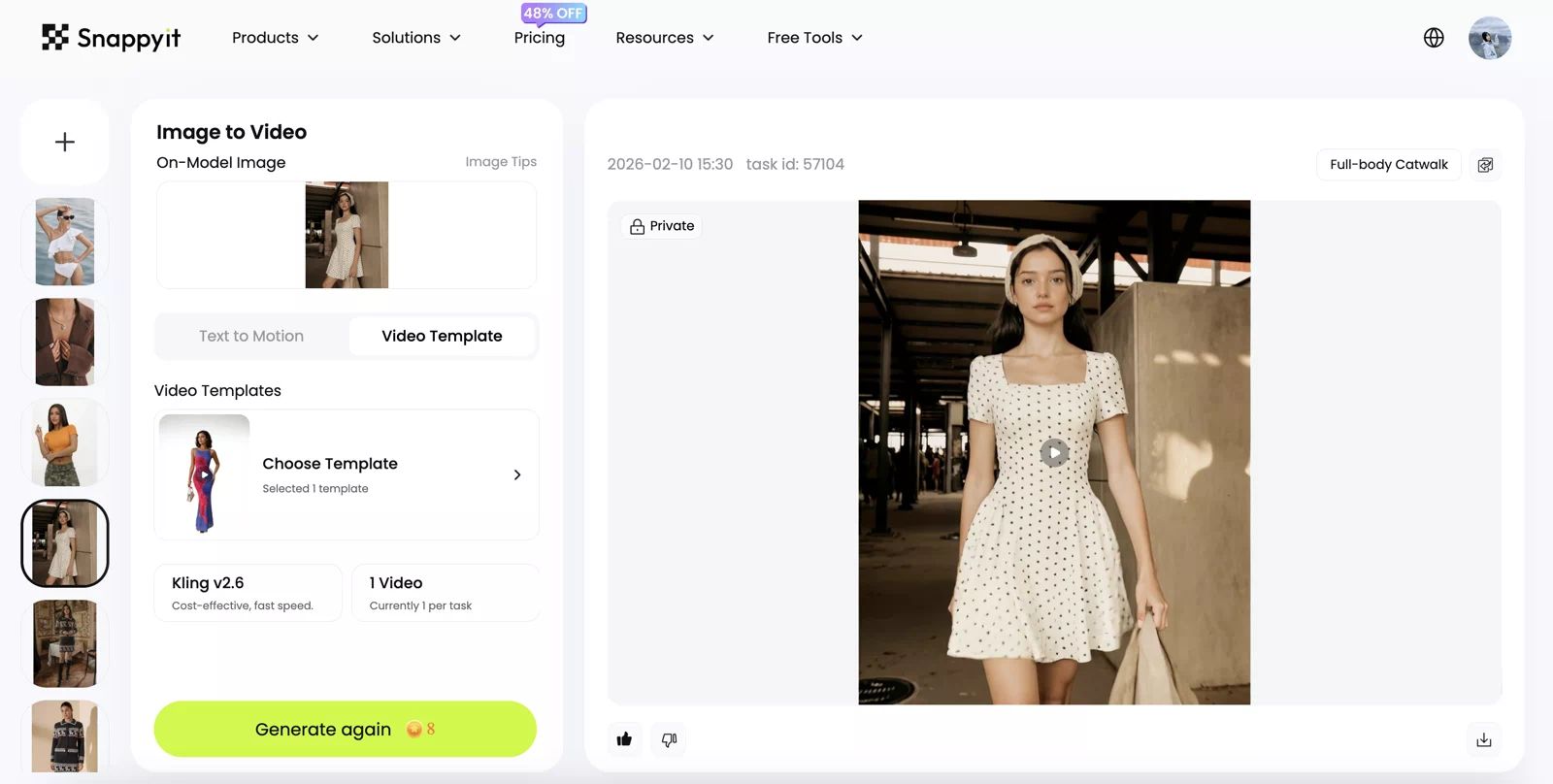
Product fidelity: Good in the sampled frames. The dot pattern, square neckline, short sleeves, and skirt shape remain stable. Hands, the carried item, waist contact, and moving hem are the highest-risk areas for frame-by-frame QA.
Image clarity: High. The original export is 1268 × 1632, H.264, and 24 fps, with good garment detail in the reviewed frames. The embedded delivery copy is optimized to 900 × 1158.
Realism: Medium-high. The walking motion and camera framing look natural in sampled frames, but the complete 5.04-second clip should still be checked for temporal warping or detail drift.
Generation cost: $0.40 per video (8 credits × $0.05).
Original export: 5.04 seconds, 1268 × 1632, H.264, 24 fps. Embedded copy optimized to 900 × 1158 for web delivery.
For example, one approved product master can support:
- a clean product reveal;
- a slow camera push or orbit;
- a model or lifestyle scene;
- a three-frame feature sequence;
- multiple hooks or opening shots;
- several aspect ratios;
- localized captions and calls to action.
The product layer stays stable while the hook, environment, motion, copy, and format change. Merchants can reuse the same verified source package and approval baseline, but every derivative still needs product and brand QA before publication.
Video QA should check frame-by-frame product shape, logo and text stability, color, hands or model interaction, motion artifacts, and the final frame used for the call to action.
Test creative ideas without losing the brand
Creative range and brand consistency are not opposites. Clear limits make testing more useful because the team knows which variable changed.
A strong social production batch changes one or two dimensions at a time:
- hook or opening frame;
- background or scene;
- model or styling;
- crop and composition;
- motion pattern;
- message or call to action.
If every element changes at once, the team cannot tell what caused the performance difference and cannot turn the result into a reusable workflow.
Run listing and social content from the same product master
The listing and social workflows should share one approved product source while optimizing for different outcomes:
- Listings establish product truth: consistent, accurate, compliant, and scalable.
- Social media builds attention around that truth: creative, on-brand, channel-native, and efficient to turn into video.
This is the practical merchant model for AI product photography: approve the product once, use specialist tools for repeatable listing jobs, and let marketing create around that approved truth. The result is not simply more AI images. It is a catalog that launches faster and a content engine that can keep up with it.
FAQ: AI Product Photography (2026)
1. What is the best AI product photography tool in 2026?
There is no single best tool for every product photography job. The best choice is a dependable, task-specific tool for the step that slows down your workflow: AI flat lay tools for consistent overhead catalog images, AI ghost mannequin tools for structured apparel views, AI color change tools for verified color variants, AI fashion model tools for on-body context, and image-to-video tools for short-form motion. Judge the tool by product accuracy, first-pass approval, channel readiness, and repeatability—not by one dramatic demo. The linked examples are five workflows within the single platform tested for this guide; they are not a multi-vendor ranking.
2. Can AI create product photos for ecommerce stores?
Yes. AI can turn real product inputs into white-background images, flat lays, ghost-mannequin views, model images, color variants, lifestyle scenes, social crops, and short videos. For ecommerce use, the generation is only one step: each output should remain connected to the correct SKU, pass human product-accuracy QA, and be exported for the right channel and image slot.
3. Is AI product photography good for Shopify stores?
Yes. Shopify merchants control their storefront, theme, and product gallery, so AI images can support flat lays, model views, color variants, and campaign assets when they accurately represent the SKU. There is no single marketplace-style main-image rule for every Shopify store. Check the active theme's media behavior, crop and aspect-ratio choices, image quality, and accessibility text before publishing [2].
4. Is AI product photography suitable for Amazon listings?
It can be, but acceptance depends on the Amazon marketplace, product category, image type, and current requirements. Do not assume that a flat lay, ghost-mannequin image, model image, or overlay is permitted in the main-image slot. Check Amazon's current product image requirements for the exact listing before publishing [1]. An attractive image that fails a channel rule is still a draft.
5. Can AI generate product photos with models?
Yes. AI fashion model tools can place clothing or accessories on a realistic model without arranging a new shoot for every SKU. Use the result as visual styling and approximate on-body context—not as proof of actual fit or sizing. Verify apparent length, drape, coverage, prints, logos, pockets, straps, and any areas where hands or hair overlap the product. Keep product-only images, detail photos, measurements, and size information as the primary evidence of what the buyer will receive.
6. How should merchants review AI product images before publishing?
Start by confirming that the merchant has the right to use and edit the source material, then review the AI provider's current terms for the intended commercial use [5]. Compare every output with the verified source package linked to the physical SKU, and check product integrity, brand rules, copy, claims, disclosure obligations, and the destination platform's policy. This operational checklist is not legal advice; when rights or regulatory obligations are unclear, obtain appropriate legal review.
7. Is AI product photography better than hiring a photographer?
It is not a blanket replacement for every photoshoot. AI is most useful for repeatable catalog jobs, missing variants, standardized listing views, channel adaptations, and social derivatives at scale. The source of product truth should be a verified package linked to the physical SKU, including original photos, product data, measurements, and color references. AI helps the team publish more assets from that package without rebuilding every image by hand.
8. Do I need design or photography skills to use AI product photography tools?
You do not need to become an expert prompt writer, but you do need a clear production brief and review process. Start with accurate source photos, define the required image slot and channel specifications, state which product details must not change, and compare every result with the real item. A reusable template and checklist matter more than inventing a new prompt for every SKU.
9. Can AI improve existing product photos?
Yes. AI can remove distracting backgrounds, correct lighting, clean minor wrinkles, standardize framing, and turn mixed supplier or phone photos into a consistent catalog set. For apparel, AI flat lay tools is a practical starting point. Always compare the result with the source around hems, collars, straps, pockets, prints, texture, and asymmetrical details so cleanup does not redesign the product.
10. Are there free AI product photography tools?
Some providers offer free credits, trials, or limited free workflows. At the time this guide was reviewed, the linked AI product photography tools offered a free entry point without a credit card [6]; availability and plan terms can change, so check the current product and pricing pages [7]. Test with a real SKU and evaluate the approved result—not only generation speed.
References
- Amazon Seller Central — Product image requirements.
- Shopify Help Center — Product media types.
- Meta Business Help Center — Instagram Reels ads guidance.
- TikTok for Business — Auction in-feed ad specifications.
- Snappyit — Terms of Service.
- Snappyit — AI Product Photography.
- Snappyit — Pricing.
- Workflow pages used for the hands-on examples: AI Flat Lay, AI Ghost Mannequin, AI Color Change, AI Fashion Model, and Image to Video.